Introduction
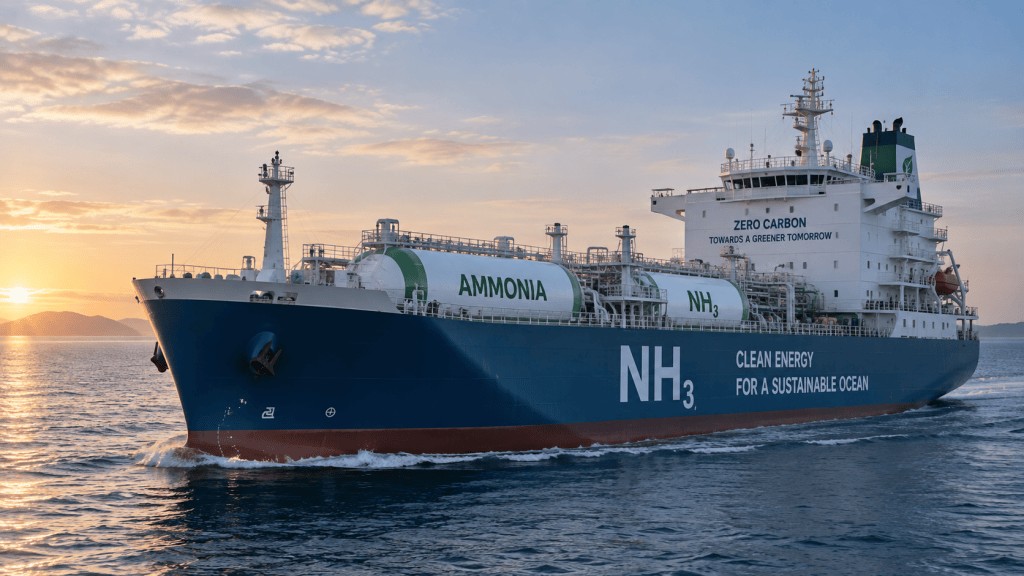
As the maritime industry searches for fuels capable of supporting deep decarbonisation, ammonia has emerged as one of the most closely watched alternatives for future shipping. Unlike conventional marine fuels, ammonia contains no carbon in its molecular structure, meaning that it does not produce carbon dioxide directly from the fuel during combustion.
However, this does not automatically make ammonia a zero-GHG fuel. Its overall environmental performance depends heavily on how the ammonia is produced, while challenges related to toxicity, onboard safety, combustion, emissions control, fuel availability and infrastructure still need to be addressed.
For these reasons, ammonia represents both a significant opportunity and a major technical challenge for the future of maritime decarbonisation.
1. What Is Ammonia?
Ammonia is a compound of nitrogen and hydrogen, with the chemical formula NH₃. It has long been produced and transported globally, particularly for use in fertilisers and other industrial applications.
Its lack of carbon is one of the main reasons it has attracted attention as a potential marine fuel. When ammonia is used as a fuel, there are no direct CO₂ emissions from the ammonia itself.
However, ammonia has different physical and combustion characteristics from conventional marine fuels. Ships designed to use ammonia therefore require dedicated fuel storage, supply, safety and emissions-control systems.
2. Different Types of Ammonia
The environmental performance of ammonia depends strongly on its production pathway.
Conventional ammonia is generally produced using fossil fuels, particularly natural gas and coal. As a result, conventional ammonia can be associated with significant upstream greenhouse gas emissions.
Blue ammonia is typically produced from fossil fuels combined with carbon capture and storage. Its lifecycle emissions depend on factors including the production process, carbon capture rate and upstream emissions.
Green ammonia is produced using hydrogen generated from water electrolysis powered by renewable electricity, with nitrogen generally obtained from the air. This pathway has the potential to achieve much lower lifecycle greenhouse gas emissions.
Therefore, the long-term decarbonisation potential of ammonia in shipping will depend largely on expanding the availability of ammonia produced with very low lifecycle GHG emissions.
3. Key Advantages of Ammonia as a Marine Fuel
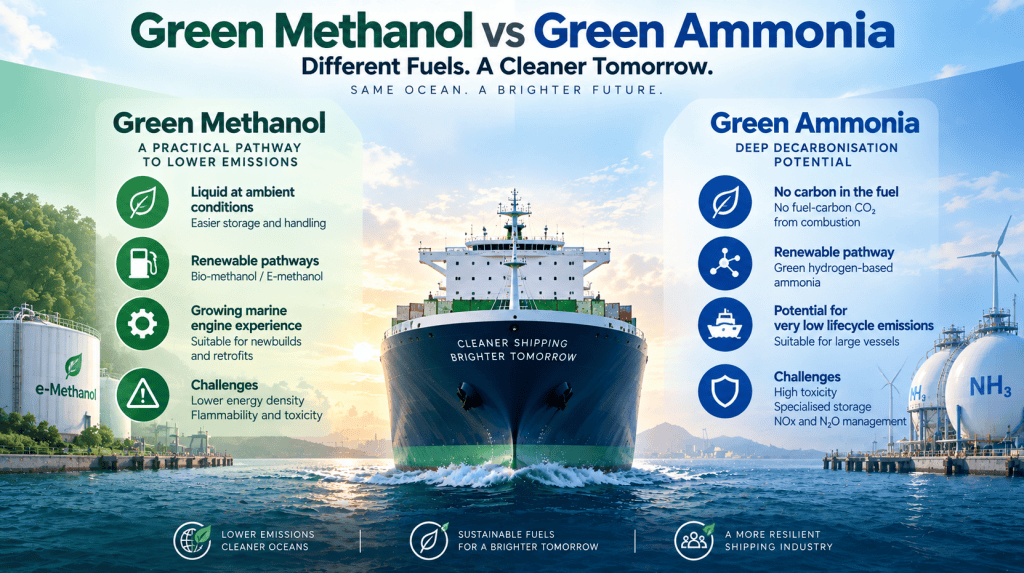
The most important advantage of ammonia is that it contains no carbon. This makes it fundamentally different from carbon-containing fuels such as LNG and methanol when considering direct CO₂ emissions from onboard fuel use.
Ammonia can also be stored in liquid form without the extremely low temperatures required for liquid hydrogen. This may make it more practical for some deep-sea applications where large quantities of energy need to be carried onboard.
Another potential advantage is the existence of a global ammonia production and transportation industry. Although marine fuel demand would require substantial additional low-GHG production and bunkering infrastructure, the maritime sector is not starting entirely from zero in terms of industrial experience with ammonia.
4. Safety and Toxicity Challenges
Safety is one of the most important challenges associated with ammonia as a marine fuel.
Ammonia is highly toxic, and accidental leakage can create serious risks for crew members, port personnel and surrounding areas. Vessel design therefore needs to minimise the possibility of leakage and provide appropriate detection, ventilation, isolation and emergency-response arrangements.
Fuel tanks, piping systems, fuel preparation rooms and bunkering arrangements must be carefully designed to prevent exposure. Crew training and operating procedures will also be particularly important.
IMO has already developed interim safety guidelines for ships using ammonia as fuel, reflecting the growing need for a regulatory framework as ammonia-fuelled vessel projects move towards practical operation.
5. Combustion and Emissions Challenges
Although ammonia contains no carbon, its combustion presents other environmental and technical challenges.
Ammonia has different ignition and combustion characteristics from conventional marine fuels, making stable and efficient combustion more difficult. Some engine concepts may therefore use a pilot fuel to support ignition.
Nitrogen oxides (NOx) and nitrous oxide (N₂O) also require careful attention. In particular, N₂O is a powerful greenhouse gas, meaning that controlling these emissions is important if ammonia is to deliver strong overall climate benefits.
Unburned ammonia, often referred to as ammonia slip, is another issue that needs to be controlled through engine design and emissions-treatment technologies.
The environmental performance of an ammonia-fuelled vessel therefore depends not only on eliminating direct carbon emissions from the fuel but also on effectively controlling other emissions.
6. Fuel Storage and Vessel Design
Ammonia has a lower volumetric energy density than conventional marine fuels. Consequently, a larger fuel volume may be required to achieve a similar sailing range.
This can affect vessel arrangement, cargo capacity and the location and size of fuel tanks. The impact will vary depending on vessel type, trading route and bunkering strategy.
For newbuild vessels, these requirements can be considered during the initial design stage. Retrofitting an existing ship may be more complicated because sufficient space must be found for tanks, fuel supply equipment, safety systems and associated machinery.
As with other alternative fuels, the technical and commercial suitability of ammonia therefore needs to be assessed on a vessel-by-vessel basis.
7. Green Ammonia and Lifecycle Emissions
The greatest potential environmental benefit is expected from ammonia produced using low-GHG energy pathways.
Green ammonia produced using renewable electricity can potentially achieve substantially lower lifecycle greenhouse gas emissions than conventional fossil-based ammonia.
This distinction is increasingly important because maritime regulation is moving towards evaluating fuels on a lifecycle basis rather than considering only emissions produced onboard a vessel.
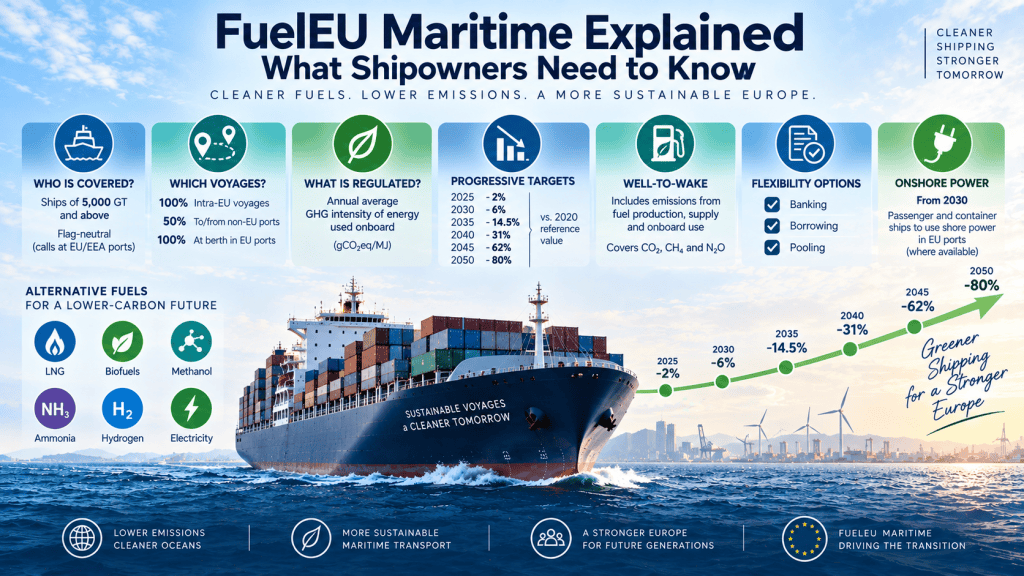
Under a Well-to-Wake approach, emissions associated with fuel production, processing, transportation and onboard use are considered together. Consequently, simply describing ammonia as a “zero-carbon fuel” can be misleading unless its production pathway is also considered.
8. Infrastructure and Commercial Challenges
Large-scale adoption of ammonia will require significant expansion of low-GHG ammonia production, transportation, storage and marine bunkering infrastructure.
Cost will also be a major consideration. Producing green ammonia requires substantial quantities of renewable electricity and renewable hydrogen, and sufficient production capacity will need to be developed to meet potential future demand from shipping and other industries.
Ports will also require appropriate bunkering facilities and safety procedures.
The challenge is therefore not simply developing an ammonia-capable engine. A complete fuel ecosystem needs to develop alongside the vessels that will consume the fuel.
9. Is Ammonia Moving Towards Commercial Shipping?
Ammonia propulsion is moving beyond the purely conceptual stage. Engine development, vessel orders, demonstrations and regulatory work have progressed significantly in recent years. DNV reported in 2025 that ammonia-capable ships were already on order and described the technology as moving from theory towards deployment.
At the same time, the technology remains at an earlier stage of commercial development than conventional marine fuels. Safety, fuel availability, cost, crew competence and infrastructure remain important barriers to widespread adoption.
The transition is therefore likely to be gradual, with early applications helping the industry build operational experience before ammonia can potentially achieve broader use in deep-sea shipping.
10. Can Ammonia Become a Zero-Carbon Shipping Fuel?
Ammonia has the potential to become an important fuel for very low-GHG shipping, particularly because it contains no carbon and can potentially be produced using renewable energy.
However, the answer depends on the entire fuel pathway.
If ammonia is produced using carbon-intensive fossil energy, its lifecycle greenhouse gas benefits can be limited. If it is produced using renewable energy and its onboard emissions are effectively controlled, its decarbonisation potential can be substantially greater.
For this reason, the future of ammonia in shipping will depend not only on vessel and engine technology, but also on the development of reliable supplies of competitively priced low-GHG ammonia.
Conclusion
Ammonia offers one of the most interesting potential pathways towards deep decarbonisation of international shipping. Its carbon-free molecular structure provides an important advantage, particularly for sectors where large quantities of energy are required for long-distance operation.
However, significant challenges remain. Toxicity, safety, combustion characteristics, NOx and N₂O emissions, fuel storage, infrastructure, production capacity and cost all need to be addressed.
Most importantly, ammonia should not automatically be considered a zero-GHG fuel simply because it contains no carbon. Its true environmental benefit depends on its lifecycle emissions and production pathway.
If the maritime industry can successfully develop safe vessel technology alongside sufficient supplies of competitively priced low-GHG ammonia, the fuel could become an important part of the future energy mix for deep-sea shipping.


답글 남기기