Introduction
Improving ship energy efficiency is not only about installing new equipment.
A vessel may have an efficient engine, optimised propeller, wind-assisted propulsion or an air lubrication system, but the way the ship is operated and managed remains equally important.
This is where the Ship Energy Efficiency Management Plan (SEEMP) becomes important.
SEEMP provides a structured framework for shipowners and operators to monitor, manage and improve the energy efficiency of their vessels.
It is closely connected with fuel-consumption reporting and the IMO Carbon Intensity Indicator (CII).
In simple terms:
EEXI looks at the technical efficiency of an existing ship.
CII measures its annual operational carbon intensity.
SEEMP provides the management framework for improving its operational energy efficiency.
So what exactly is SEEMP, what are Parts I, II and III, and what does it mean for shipowners?
1. What Does SEEMP Mean?
SEEMP stands for:
Ship Energy Efficiency Management Plan
IMO describes SEEMP as an operational mechanism for improving the energy efficiency of ships in a cost-effective manner.
Rather than prescribing one specific technology, SEEMP encourages shipowners and operators to continuously consider technologies and operational practices that can improve vessel performance.
A SEEMP is ship-specific.
This is important because no two vessels necessarily operate under exactly the same conditions.
A bulk carrier trading on long ocean routes may require a different efficiency strategy from a ferry operating a fixed short-distance schedule.
The purpose is therefore not simply to produce another compliance document.
A properly implemented SEEMP should provide a practical process for:
Planning → Implementation → Monitoring → Evaluation → Improvement
2. Why Was SEEMP Introduced?
Shipping energy efficiency depends on both technology and operation.
Even two technically identical ships can have very different fuel consumption depending on how they are operated.
Factors may include:
- Vessel speed
- Voyage planning
- Weather routing
- Hull condition
- Propeller condition
- Machinery operation
- Trim
- Cargo loading
- Port waiting time
- Maintenance practices
SEEMP provides a framework for systematically identifying and managing these factors.
The overall objective is straightforward:
Reduce unnecessary energy consumption while maintaining safe and effective vessel operation.
3. Which Ships Need SEEMP?
Under MARPOL Annex VI, ships of 400 gross tonnage and above that are subject to the relevant energy-efficiency requirements are required to keep a ship-specific SEEMP onboard.
However, not every part of SEEMP applies identically to every ship.
The requirements become more extensive for larger vessels, particularly ships of 5,000 GT and above that are subject to IMO fuel-consumption data collection and CII requirements.
This is why understanding the different parts of SEEMP is important.
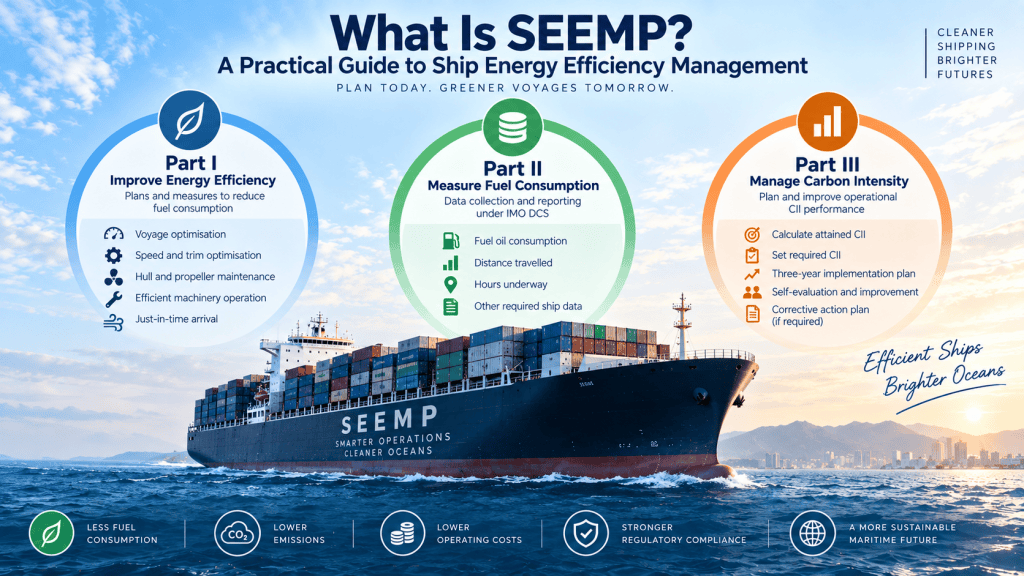
4. SEEMP Has Three Main Parts
Under the current IMO framework, SEEMP consists of three main components:
Part I
Ship Management Plan to Improve Energy Efficiency
Part II
Ship Fuel Oil Consumption Data Collection Plan
Part III
Ship Operational Carbon Intensity Plan
These three parts perform different functions but work together as part of the ship’s overall energy-management framework.
A simple way to remember them is:
Part I → Improve
Part II → Measure
Part III → Manage Carbon Intensity
Let’s examine each one.
5. SEEMP Part I — Improving Energy Efficiency
Part I establishes the ship’s approach to improving energy efficiency and reducing operational carbon intensity.
It can cover a wide range of measures.
Voyage Optimisation
Better route planning can reduce unnecessary sailing distance and avoid unfavourable weather conditions.
Speed Optimisation
Speed has a major influence on propulsion power and fuel consumption.
Operating at an appropriate speed can therefore significantly affect energy performance.
Hull and Propeller Maintenance
Marine growth increases resistance.
Regular hull cleaning and maintaining good propeller condition can help reduce the power required to move the vessel through the water.
Trim Optimisation
Optimising vessel trim can reduce resistance under certain operating conditions.
Machinery Management
Efficient operation of engines, pumps, fans and auxiliary systems can reduce unnecessary energy consumption.
Just-in-Time Arrival
Better coordination between ships and ports may allow vessels to reduce speed rather than arriving early and waiting for a berth.
Part I can therefore combine both technical and operational efficiency measures.
6. SEEMP Part II — Fuel Oil Consumption Data
Part II addresses the IMO Data Collection System (DCS) for ship fuel oil consumption.
IMO introduced mandatory requirements for applicable ships to record and report fuel oil consumption so that reliable data could support energy-efficiency and GHG reduction measures.
For applicable ships, the SEEMP must describe how the required data will be collected and reported.
This may include information relating to:
- Fuel oil consumption
- Distance travelled
- Hours underway
- Other required ship data
The principle is important:
You cannot effectively manage energy performance without reliable data.
Part II therefore provides the measurement foundation for the wider operational efficiency framework.
7. SEEMP Part III — Managing CII
Part III connects SEEMP directly with the Carbon Intensity Indicator (CII).
For ships subject to CII requirements, SEEMP Part III includes key elements relating to how the vessel will achieve its required annual operational CII.
These include:
- Methodology for calculating attained annual operational CII
- Required annual operational CII
- A three-year implementation plan
- Procedures for self-evaluation and improvement
For ships receiving poor CII ratings, corrective action requirements also become relevant.
This makes Part III particularly important because SEEMP is no longer simply about general energy-saving intentions.
It becomes directly connected to measurable annual carbon-intensity performance.
8. What Is the Relationship Between SEEMP and CII?
SEEMP and CII should not be confused.
CII Is a Performance Indicator
It tells us how the ship performed in terms of annual operational carbon intensity.
SEEMP Is a Management Framework
It describes how the ship will manage and improve its energy and carbon-intensity performance.
An easy way to understand the relationship is:
CII tells you the result.
SEEMP helps you manage the process that produces the result.
For applicable ships, the attained annual operational CII is verified against the required annual CII and used to determine the ship’s A–E rating.
9. What Do CII Ratings Mean?
Ships subject to CII receive an annual rating:
A — Major superior
B — Minor superior
C — Moderate
D — Minor inferior
E — Inferior
A ship rated D for three consecutive years, or E for one year, must develop a corrective action plan showing how it will achieve the required rating of C or above.
This corrective action becomes part of the SEEMP framework.
SEEMP therefore plays an important role not only in normal efficiency management but also in addressing underperformance.
10. What Could a Corrective Action Plan Include?
The appropriate corrective measures will depend on the vessel.
Potential actions may include:
- Speed optimisation
- Improved voyage planning
- Weather routing
- Hull cleaning
- Propeller maintenance
- Machinery optimisation
- Energy-saving devices
- Wind-assisted propulsion
- Air lubrication
- Alternative fuels
- Improved operational procedures
A shipowner may also need to investigate why the vessel failed to achieve its required CII.
The correct solution should address the underlying cause rather than simply adding equipment.
For example, if poor hull condition is responsible for excessive fuel consumption, improving hull maintenance may provide a more immediate benefit than installing an unrelated technology.
11. SEEMP Should Be Based on Real Ship Data
An effective SEEMP should not be based purely on theoretical assumptions.
Actual operating data can help identify where energy is being consumed and where improvements may be possible.
Useful information may include:
- Main engine fuel consumption
- Auxiliary engine consumption
- Boiler consumption
- Vessel speed
- Shaft power
- Weather conditions
- Draft
- Trim
- Hull condition
- Propeller condition
- Voyage duration
- Port waiting time
Digital monitoring systems can make this process increasingly sophisticated.
Instead of reviewing performance only after a voyage, ship operators can increasingly monitor energy performance continuously.
12. Digitalisation Can Strengthen SEEMP
Modern ship energy management is becoming increasingly data-driven.
Digital platforms can combine data from:
Engines + Navigation + Weather + Hull Performance + Fuel Consumption
This can allow operators to identify inefficient operating conditions more quickly.
Artificial intelligence and advanced analytics may also help identify patterns that would be difficult to detect manually.
For example, digital tools may help determine:
- Most efficient operating speed
- Optimal trim
- Hull performance deterioration
- Propeller efficiency loss
- Machinery anomalies
- Fuel-consumption trends
SEEMP may therefore increasingly evolve from a static document into a more dynamic energy-management process.
13. Where Do Energy-Saving Technologies Fit?
SEEMP does not require one particular energy-saving technology.
Instead, shipowners can evaluate technologies appropriate for their vessels.
These could include:
Wind-Assisted Propulsion
WAPS can generate additional propulsion force from wind and reduce the power required from the main engine.
Air Lubrication Systems
ALS can reduce frictional resistance between the hull and seawater.
Propeller and Hull Improvements
Optimised propellers, ducts, fins and other energy-saving devices may improve propulsion efficiency.
Waste Heat Recovery
Energy otherwise lost through exhaust gas or cooling systems may be recovered for useful purposes.
The important issue is not simply whether a technology is installed.
It is whether the technology produces a verified net improvement in vessel energy performance.
14. Alternative Fuels and SEEMP
Fuel selection can also influence operational carbon performance.
Potential options include:
- Biofuels
- LNG
- Methanol
- Ammonia
- Hydrogen
- Synthetic fuels
However, the fuel name alone does not determine its environmental performance.
Increasingly, shipping needs to consider Well-to-Wake lifecycle GHG emissions.
The production pathway therefore matters.
For example, renewable e-methanol can have a very different lifecycle footprint from fossil methanol.
Similarly, green ammonia can have a very different GHG profile from ammonia produced from unabated fossil energy.
SEEMP should therefore be viewed within the wider transition towards lifecycle-based maritime decarbonisation.
15. SEEMP Is More Than Compliance
There is a risk that SEEMP becomes viewed simply as another document required onboard.
That misses its potential value.
A well-designed energy-management process can help a shipowner:
- Reduce fuel costs
- Improve operational efficiency
- Identify performance deterioration
- Support CII performance
- Evaluate retrofit investments
- Compare vessels within a fleet
- Prepare for future GHG requirements
Fuel remains a major operating cost for many vessels.
Therefore:
Energy efficiency can deliver both environmental and commercial benefits.
16. Fleet-Level Energy Management
Although SEEMP is ship-specific, energy management should not necessarily stop at individual vessels.
A company operating multiple ships can compare performance across the fleet.
For example:
Why does one vessel consume more fuel than a sister ship?
Why has another vessel’s performance deteriorated over the last six months?
Which ship would benefit most from a WAPS retrofit?
Which vessel should receive hull cleaning first?
Which operating practices produce the best CII results?
Fleet-level analysis can turn individual ship data into broader commercial and technical decisions.
17. SEEMP, EEXI and CII Together
These three elements form an important part of IMO’s short-term GHG reduction measures.
Their roles can be summarised as:
EEXI
Technical efficiency of existing ships
CII
Annual operational carbon-intensity performance
SEEMP
Management framework for improving ship energy and carbon-intensity performance
They should therefore not be viewed independently.
A technically efficient ship can still be operated inefficiently.
Likewise, good operational practices cannot completely compensate for poor underlying vessel efficiency.
Effective decarbonisation requires both.
18. SEEMP Is Still Evolving
SEEMP should not be viewed as a finished regulatory framework.
IMO completed Phase 1 of its review of the short-term GHG reduction measures in 2025 and moved into Phase 2 for 2026–2028.
The Phase 2 work includes further enhancement of the SEEMP framework and development of CII metrics.
This means shipowners should expect SEEMP and the wider operational efficiency framework to continue developing as IMO’s GHG regulations evolve.
19. A Practical SEEMP Approach
For shipowners, a practical approach can be summarised in five steps:
1. Measure
Understand where and how the vessel consumes energy.
2. Identify
Find the largest sources of inefficiency.
3. Improve
Apply operational or technical measures.
4. Verify
Measure whether the changes actually reduce energy consumption.
5. Repeat
Continue improving as operating conditions, technology and regulations evolve.
This continuous improvement cycle is ultimately the most important principle behind effective ship energy management.
Conclusion
SEEMP is much more than a document kept onboard a ship.
It provides a structured framework for managing energy efficiency, collecting fuel-consumption data and improving operational carbon-intensity performance.
Its three main components can be remembered simply:
Part I — Improve energy efficiency
Part II — Collect and report fuel-consumption data
Part III — Manage operational carbon intensity
Together with EEXI and CII, SEEMP forms an important part of IMO’s current approach to reducing emissions from the existing fleet.
For shipowners, however, the greatest value of SEEMP may go beyond regulatory compliance.
A properly implemented energy-management strategy can help answer a much more practical question:
“Where is our ship wasting energy, and what is the most effective way to reduce it?”
As regulations become more demanding and fuel choices become more complex, the ability to answer that question accurately will become increasingly important.



답글 남기기