Introduction
The European Union Emissions Trading System (EU ETS) has fundamentally changed the economics of shipping to and from Europe.
Since 1 January 2024, maritime transport has been included in the EU ETS, requiring shipping companies to account for greenhouse gas emissions from voyages involving European ports.
The principle is straightforward:
The more greenhouse gas emissions a ship generates within the scope of the EU ETS, the more emission allowances the responsible shipping company must surrender.
This effectively introduces a carbon cost into vessel operation.
For shipowners, operators and charterers, the implications go beyond regulatory compliance.
Fuel efficiency, voyage planning, alternative fuels and energy-saving technologies can now directly influence not only fuel costs but also exposure to carbon costs.
This article explains how the EU ETS applies to shipping, which voyages and emissions are covered, how EU Allowances work, and what shipowners should consider as the system moves into full implementation.
1. What Is the EU ETS?
The EU Emissions Trading System is a cap-and-trade system.
A cap limits the total greenhouse gas emissions permitted from sectors covered by the system.
Companies must surrender emission allowances corresponding to emissions for which they are responsible.
One allowance — commonly referred to as an EU Allowance or EUA — represents the right to emit:
One tonne of CO₂ equivalent (CO₂e).
The total cap is progressively reduced, creating an economic incentive to reduce emissions. Maritime transport has been included in the EU ETS since 2024.
2. Which Ships Are Covered?
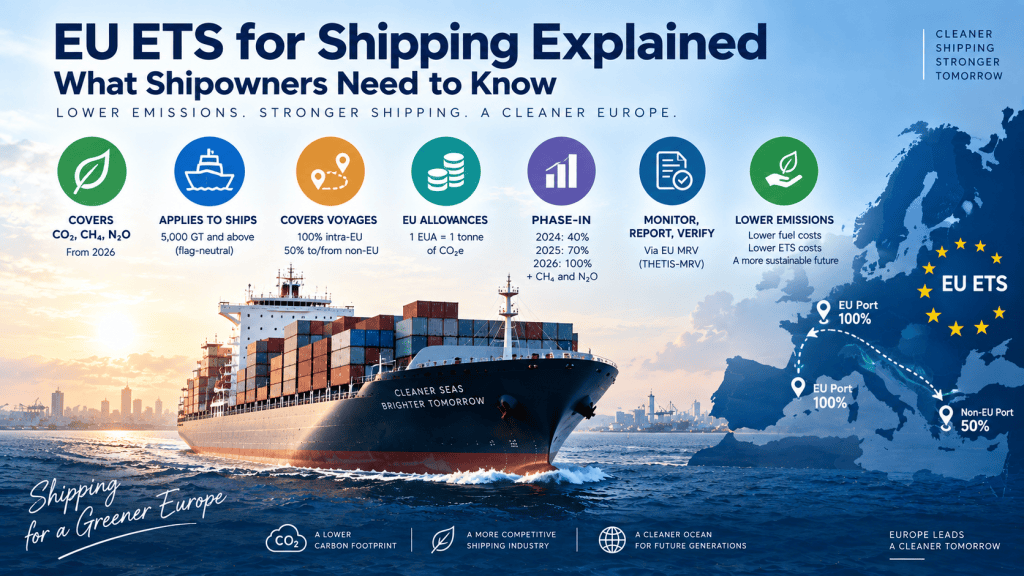
Since 2024, the EU ETS maritime scope has covered cargo and passenger ships of:
5,000 gross tonnage (GT) and above
when they fall within the applicable voyage and port scope.
The regulation is flag-neutral.
This means a ship does not need to be registered in an EU country to fall within the system.
A Korean, Japanese, Singaporean or other non-EU-flagged vessel can therefore be covered when it performs qualifying voyages involving EU/EEA ports.
From 2027, offshore ships of 5,000 GT and above are also scheduled to enter the EU ETS scope.
The related EU MRV system has a broader ship scope in certain respects: from 2025 it also covers specified offshore and general cargo ships from 400 GT upwards for monitoring and reporting purposes.
3. Which Voyages Are Covered?
The geographical rules are particularly important.
For voyages between two ports within the EU ETS geographical scope:
100% of emissions are covered.
For emissions occurring while the ship is within an EU port:
100% of emissions are covered.
For voyages between an EU port and a non-EU port:
50% of voyage emissions are covered.
For example:
Rotterdam → Hamburg
Both ports are within the relevant EU scope.
100% of the voyage emissions are covered.
Busan → Rotterdam
This is an extra-European voyage.
50% of the relevant voyage emissions are covered.
Rotterdam → Busan
Again:
50% of the relevant voyage emissions are covered.
This route-based approach means that vessels trading internationally can have significant EU ETS exposure even when most of their voyage takes place outside European waters.
4. What About Emissions in Port?
EU ETS does not apply only while the vessel is sailing.
For applicable ships, 100% of emissions within an EU port of call are included.
These can include emissions generated:
- At berth
- During cargo operations
- During hoteling
- During movements within the port
This means auxiliary engine and boiler fuel consumption can also contribute to ETS exposure.
Reducing energy consumption while in port can therefore have both environmental and economic value.
5. How Was the EU ETS Phased In?
The maritime EU ETS was introduced gradually.
The surrender obligations are:
2024 emissions
40%
Allowances surrendered in 2025.
2025 emissions
70%
Allowances surrendered in 2026.
2026 emissions onwards
100%
Allowances for 2026 emissions are surrendered in 2027.
This distinction is important.
In calendar year 2026, shipping companies surrender allowances covering 70% of the applicable emissions reported for 2025.
However, emissions generated during 2026 itself are subject to the 100% phase-in level and will feed into the following year’s surrender obligation.
6. CO₂ Is No Longer the Only Greenhouse Gas
Another major change occurs in 2026.
During 2024 and 2025, EU ETS surrender obligations for maritime transport covered CO₂.
From 2026, the EU ETS also covers:
CH₄ — Methane
and
N₂O — Nitrous oxide
alongside CO₂.
The EU MRV Maritime Regulation had already required monitoring of CO₂, CH₄ and N₂O from 2024; the latter two enter the ETS scope from 2026.
This is particularly important when evaluating marine fuels and propulsion technologies.
For example, methane emissions can be relevant to LNG-fuelled ships, while N₂O can be relevant when evaluating certain future fuel pathways and combustion technologies.
The carbon-cost analysis therefore increasingly needs to consider CO₂-equivalent greenhouse gas emissions, not simply CO₂ at the funnel.
7. What Is an EU Allowance?
An EU Allowance represents permission to emit:
1 tonne of CO₂e
under the EU ETS.
Shipping companies must surrender the required number of allowances through the Union Registry.
The financial exposure can therefore be thought of conceptually as:
ETS-covered emissions × EUA requirement × EUA price
However, the market price of EUAs changes over time.
This means EU ETS costs are not fixed.
For shipowners and charterers, carbon-price exposure can therefore become another variable alongside:
- Fuel price
- Freight rates
- Bunker consumption
- Port costs
- Voyage duration
Carbon management increasingly becomes part of commercial voyage economics.
8. Who Is Responsible for EU ETS Compliance?
Under the EU framework, responsibility rests with the shipping company as defined by the applicable legislation.
This can be the shipowner or another organisation or person, such as a manager or bareboat charterer, that has assumed responsibility for operation of the ship and the relevant ISM Code duties and responsibilities.
Each shipping company is assigned to an administering authority in an EU Member State.
The administering authority oversees the company’s compliance with EU ETS requirements.
This regulatory responsibility should be distinguished from the commercial question of who ultimately bears the cost.
Depending on charter-party arrangements and contractual terms, ETS-related costs may be allocated between owners, charterers or other commercial parties.
That allocation is therefore also a contractual matter.
9. Monitoring, Reporting and Verification
EU ETS maritime compliance builds on the existing:
EU MRV — Monitoring, Reporting and Verification system.
Shipping companies must monitor greenhouse gas emissions during the reporting year.
Ship-level and company-level emissions reports must then undergo verification by an accredited verifier.
As a general annual cycle:
During the year → Monitor emissions
By 31 March of the following year → Submit verified emissions reports
By 30 September → Surrender the required EU Allowances
The administering authority may require verification earlier in certain circumstances.
Reporting is handled through THETIS-MRV, operated by the European Maritime Safety Agency.
10. Why Energy Efficiency Now Has a Direct Carbon Value
Before carbon pricing, an energy-saving technology primarily created value by reducing fuel consumption.
Under the EU ETS, the same reduction can potentially create two economic benefits:
Lower fuel consumption
and
Lower ETS exposure
Consider a ship that reduces fuel consumption through an energy-efficiency measure.
Lower fuel consumption generally means lower combustion-related greenhouse gas emissions.
If those emissions fall within EU ETS scope, fewer allowances may ultimately be required.
This strengthens the business case for evaluating efficiency technologies based on:
Fuel saving + Carbon-cost saving
rather than fuel saving alone.
11. Wind-Assisted Propulsion and EU ETS
Wind-Assisted Propulsion Systems (WAPS) use renewable wind energy to generate additional thrust.
Potential technologies include:
- Rotor sails
- Suction sails
- Wing sails
- Other automated wind propulsion systems
If WAPS reduces the main engine power required during a voyage, fuel consumption can decrease.
This can reduce both:
Fuel cost
and potentially:
EU ETS exposure
for emissions falling within the system.
However, actual economic performance should be evaluated against the vessel’s real trading pattern.
A vessel operating frequently on routes with substantial EU ETS exposure may have a different carbon-cost benefit from an otherwise identical ship trading predominantly outside the EU ETS geographical scope.
12. Air Lubrication and EU ETS
Air Lubrication Systems reduce frictional resistance between the hull and seawater by supplying air beneath the hull.
If the system produces a positive net energy saving, less propulsion energy is required.
This can reduce fuel consumption and associated greenhouse gas emissions.
Again, the economic benefit may therefore include:
Fuel saving + Avoided carbon cost
The key word is net.
The electrical or mechanical power required to operate the ALS must be included when evaluating the final energy and emissions benefit.
13. Alternative Fuels and EU ETS
Alternative fuels can also influence EU ETS exposure, but the calculation is more complex than simply assuming that every alternative fuel produces lower ETS costs.
Potential fuels include:
- LNG
- Biofuels
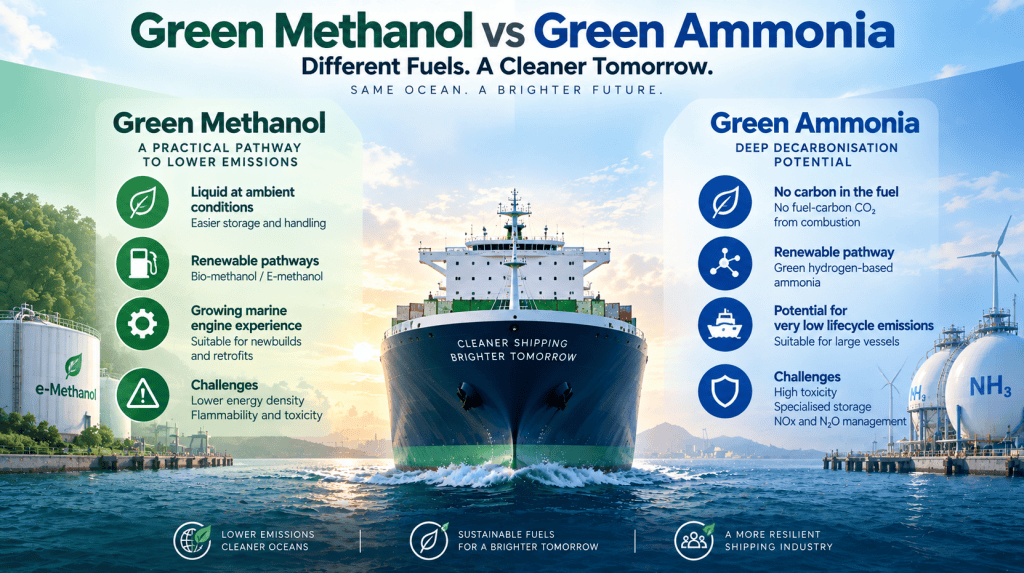
- Methanol
- Ammonia
- Hydrogen
- Synthetic fuels
Each fuel has different combustion emissions and lifecycle characteristics.
The inclusion of methane and nitrous oxide in EU ETS maritime scope from 2026 makes greenhouse-gas accounting increasingly important.
Fuel selection should therefore consider not only:
Fuel price
but also:
Energy content + Engine efficiency + GHG emissions + ETS exposure + FuelEU Maritime implications
This makes fuel economics increasingly multidimensional.
14. EU ETS and Well-to-Wake Emissions
EU ETS and Well-to-Wake analysis are related but should not be treated as identical concepts.
Well-to-Wake evaluates greenhouse gas emissions across the broader fuel lifecycle:
Fuel production → Transportation → Bunkering → Onboard use
EU ETS establishes a carbon-pricing obligation according to its own regulatory scope and accounting rules.
A fuel can therefore have one regulatory treatment under EU ETS while its broader lifecycle GHG performance requires additional analysis.
This distinction becomes especially important when comparing fossil, bio-based and synthetic fuels.
15. EU ETS vs FuelEU Maritime
EU ETS and FuelEU Maritime are often mentioned together, but they perform different functions.
EU ETS
Primarily creates a carbon price for covered greenhouse gas emissions.
In simplified terms:
More covered emissions → More allowances required → Higher potential carbon cost
FuelEU Maritime
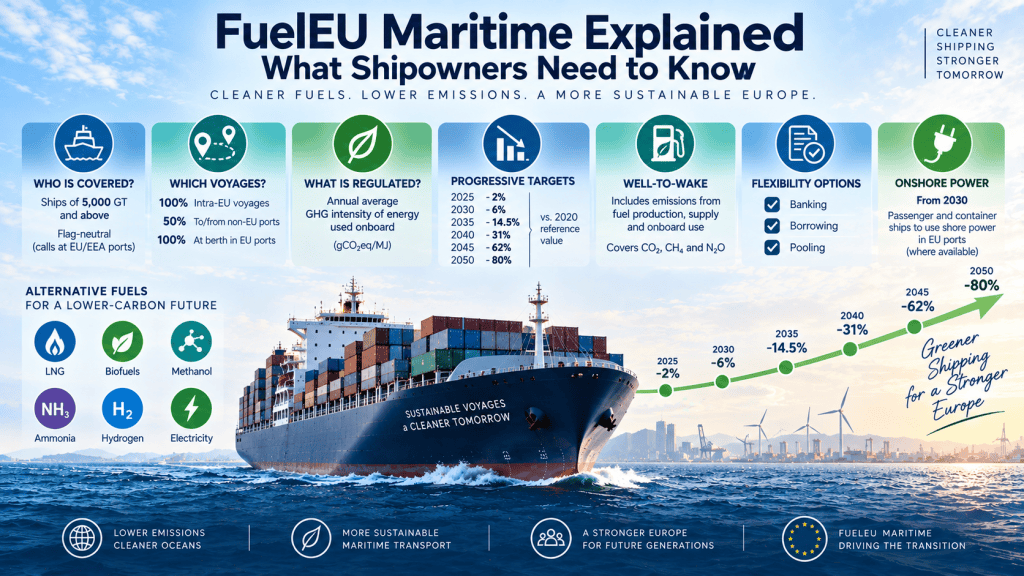
Focuses on reducing the greenhouse gas intensity of energy used onboard ships.
FuelEU Maritime has applied from 1 January 2025 and is designed to encourage renewable and low-carbon fuels and energy technologies.
The two regulations therefore work in parallel.
A useful simplified distinction is:
EU ETS → Puts a price on covered emissions
FuelEU Maritime → Pushes down the GHG intensity of onboard energy
Shipowners trading in Europe increasingly need to consider both.
16. Why FuelEU Maritime Makes Well-to-Wake Important
FuelEU Maritime places strong emphasis on the greenhouse gas intensity of energy used onboard.
This makes lifecycle emissions increasingly relevant.
For example, two fuels carrying the same name may have very different environmental performance depending on their production pathway.
Methanol can be:
- Fossil methanol
- Bio-methanol
- Renewable e-methanol
Hydrogen can be produced from:
- Fossil energy
- Fossil energy with carbon capture
- Renewable electricity
Ammonia can similarly have very different lifecycle GHG footprints.
Therefore, future marine fuel selection cannot be based only on whether a fuel produces CO₂ onboard.
The complete production pathway matters.
17. EU ETS Can Change Retrofit Economics
Consider an energy-saving retrofit that reduces annual fuel consumption.
Traditionally, the payback calculation might be:
Investment cost ÷ Annual fuel-cost saving
Under carbon pricing, the calculation becomes broader:
Investment cost ÷ (Fuel saving + Carbon-cost saving)
This does not automatically mean every efficiency technology becomes commercially attractive.
Capital cost, maintenance, downtime, vessel age and operating profile still matter.
However, EU ETS creates an additional economic value for verified emissions reductions.
This may affect investment decisions involving:
- WAPS
- ALS
- Propeller upgrades
- Hull improvements
- Digital optimisation
- Waste heat recovery
- Alternative fuels
18. Vessel Trading Pattern Matters
The same technology installed on two identical vessels may produce different EU ETS economic benefits.
Why?
Because the ships may operate on different routes.
For example:
Vessel A
Trades mainly between European ports.
A large share of its emissions may fall within EU ETS scope.
Vessel B
Trades mainly between Asian ports and only occasionally calls at Europe.
A smaller proportion of its annual emissions may fall within EU ETS scope.
Both vessels may achieve the same physical fuel saving.
But the avoided EU ETS cost can differ substantially.
This means retrofit evaluation should consider:
Technology performance + Vessel operating profile + EU ETS exposure
19. What Should Shipowners Do?
A practical EU ETS strategy should combine regulatory compliance with operational and technical planning.
Shipowners should understand:
- Which vessels are covered
- Which voyages are covered
- Which greenhouse gases are included
- How emissions are monitored
- Who is the responsible shipping company
- How allowances are acquired and surrendered
- How ETS costs are allocated contractually
- Which vessels have the highest ETS exposure
- Which efficiency investments can reduce that exposure
The objective should not simply be to purchase enough allowances.
A more strategic question is:
How can the company reduce the number of allowances it needs in the first place?
20. EU ETS Is Part of a Larger Transition
EU ETS should not be viewed in isolation.
European shipping is increasingly influenced by several interconnected regulatory frameworks, including:
EU ETS + FuelEU Maritime + EU MRV
At the same time, international shipping remains subject to IMO regulations including:
The regulatory landscape is therefore moving towards a combination of:
Technical efficiency + Operational efficiency + Lifecycle GHG intensity + Carbon pricing
This creates complexity, but it also strengthens the commercial value of genuine energy efficiency.
Conclusion
The inclusion of shipping in the EU ETS represents a major change in maritime economics.
Greenhouse gas emissions are no longer only an environmental or regulatory issue.
For vessels trading to and from Europe, they increasingly have a direct financial value.
The basic principle is:
Burn less fuel → Produce fewer emissions → Reduce potential carbon exposure
But the real picture is more complex.
Voyage geography, greenhouse gas type, fuel pathway, vessel efficiency, EUA prices and contractual arrangements all influence the final cost.
From 2026, the system becomes particularly significant because CH₄ and N₂O join CO₂ within the maritime ETS scope, while emissions generated during 2026 are subject to the full 100% phase-in level.
For shipowners, the key question is therefore moving beyond:
“How much will EU ETS cost us?”
towards:
“How can we reduce fuel consumption, greenhouse gas emissions and carbon-cost exposure at the same time?”
That question connects EU ETS directly with the wider maritime transition towards more efficient ships, lower-GHG fuels and ultimately net-zero shipping.


답글 남기기