Introduction
As shipping moves towards lower greenhouse gas emissions, green methanol and green ammonia are emerging as two important alternative marine fuels.
Both have the potential to support deep decarbonisation, but they are very different.
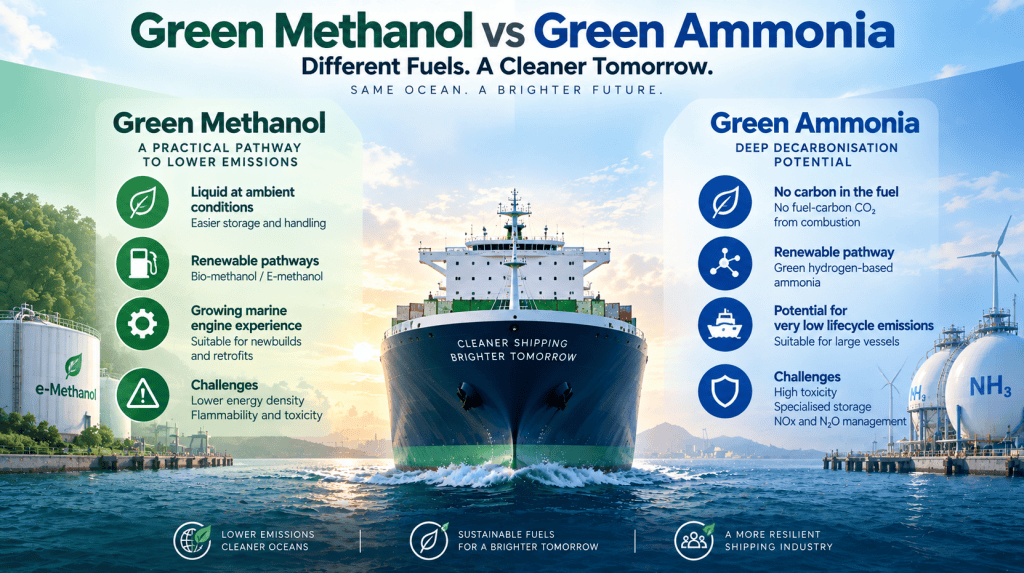
Methanol is liquid at normal ambient conditions and is relatively practical to store and handle onboard. Ammonia contains no carbon and therefore does not produce CO₂ from the fuel itself during combustion, but it introduces greater toxicity and safety challenges.
The key question is therefore not simply:
“Which fuel is greener?”
A more practical question is:
“Which fuel provides the best combination of lifecycle emissions, safety, storage, availability and cost for a particular vessel?”
1. What Are Green Methanol and Green Ammonia?
Methanol has the chemical formula CH₃OH and contains carbon.
Conventional methanol is generally produced from fossil feedstocks, while lower-GHG alternatives include bio-methanol and renewable e-methanol.
E-methanol can be produced using renewable hydrogen together with a suitable source of captured CO₂.
Ammonia has the chemical formula NH₃ and contains no carbon.
Green ammonia is generally produced using renewable hydrogen, with the hydrogen produced through electrolysis using renewable electricity.
In simplified terms:
Green Methanol:
Renewable Hydrogen + Captured CO₂ → E-Methanol
Green Ammonia:
Renewable Hydrogen + Nitrogen → Green Ammonia
In both cases, the production pathway is crucial.
A methanol- or ammonia-fuelled ship is not automatically a low-GHG ship.
2. Why Well-to-Wake Emissions Matter
Future marine fuels should not be compared only by the emissions produced onboard.
Their complete lifecycle should be considered:
Well-to-Tank + Tank-to-Wake = Well-to-Wake
Well-to-Tank includes emissions associated with producing, processing and transporting the fuel.
Tank-to-Wake covers emissions associated with using the fuel onboard.
This distinction is particularly important for hydrogen-derived fuels.
If the electricity used to produce hydrogen comes from high-carbon sources, the resulting methanol or ammonia may still have significant lifecycle emissions.
Therefore:
Fuel name alone does not determine environmental performance.
3. Green Methanol: Advantages and Challenges
One of methanol’s main advantages is practicality.
Methanol is liquid at ambient temperature and pressure, making its onboard storage comparatively straightforward.
Potential advantages include:
- Liquid storage
- Growing marine-engine experience
- Dual-fuel engine availability
- Potential retrofit applications
- Existing industrial handling experience
- Bio-methanol and e-methanol pathways
However, methanol has a lower energy density than conventional marine fuels.
Ships therefore require a greater fuel volume for equivalent voyage energy, which can affect tank space and cargo capacity.
Methanol is also flammable and toxic, requiring appropriate fuel-system design, detection, ventilation and safety procedures.
4. Green Ammonia: Advantages and Challenges
Ammonia’s greatest potential advantage is simple:
It contains no carbon.
Therefore, ammonia does not inherently produce CO₂ from the carbon content of the fuel itself during combustion.
When produced using renewable hydrogen, green ammonia could potentially support very deep lifecycle GHG reductions.
However, ammonia introduces significant challenges.
The most important is:
Toxicity
Ship design must carefully address leakage, ventilation, detection, containment, bunkering and crew protection.
Ammonia combustion can also produce nitrogen-related emissions, including NOx and potentially N₂O.
Unburned ammonia, or ammonia slip, must also be controlled.
Therefore, zero carbon in the fuel molecule does not mean zero environmental impact.
5. Storage and Ship Design
Storage is one of the clearest differences between the two fuels.
Green Methanol
Methanol is liquid under normal ambient conditions.
Its storage is therefore relatively straightforward, although larger tanks are generally required because of its lower volumetric energy density compared with conventional fuel oil.
Green Ammonia
Ammonia requires more specialised containment and safety arrangements.
Its toxicity creates additional requirements for:
- Tank location
- Ventilation
- Leak detection
- Fuel piping
- Emergency isolation
- Crew protection
For newbuild vessels, these requirements can be considered from the initial design stage.
Retrofits can be more difficult because existing vessels may have limited space for additional tanks and safety systems.
6. Safety and Emissions
Neither fuel should be regarded as risk-free.
For methanol, key considerations include:
Flammability + Toxicity
For ammonia:
High Toxicity + Leakage + Nitrogen-Related Emissions
This makes crew training particularly important.
Future alternative-fuel vessels will require not only different engines and fuel systems but also new operating procedures and safety competencies.
The fuel decision is therefore not simply an engineering choice.
It also affects vessel operation and crew management.
7. Fuel Availability and Infrastructure
A future marine fuel must be available where ships actually trade.
Both methanol and ammonia already have established industrial markets, but supplying large quantities of genuinely renewable fuel to international shipping is a much greater challenge.
Future availability will depend on:
- Renewable electricity
- Green hydrogen production
- Fuel-production capacity
- Port storage
- Bunkering infrastructure
- Transportation
- Price
For e-methanol, a suitable carbon source is also required.
Green ammonia does not require a carbon feedstock, but it still requires substantial renewable electricity and hydrogen.
Ultimately, fuel availability and price may be as important as the technical characteristics of the fuel itself.
8. FuelEU Maritime Makes the Comparison More Important
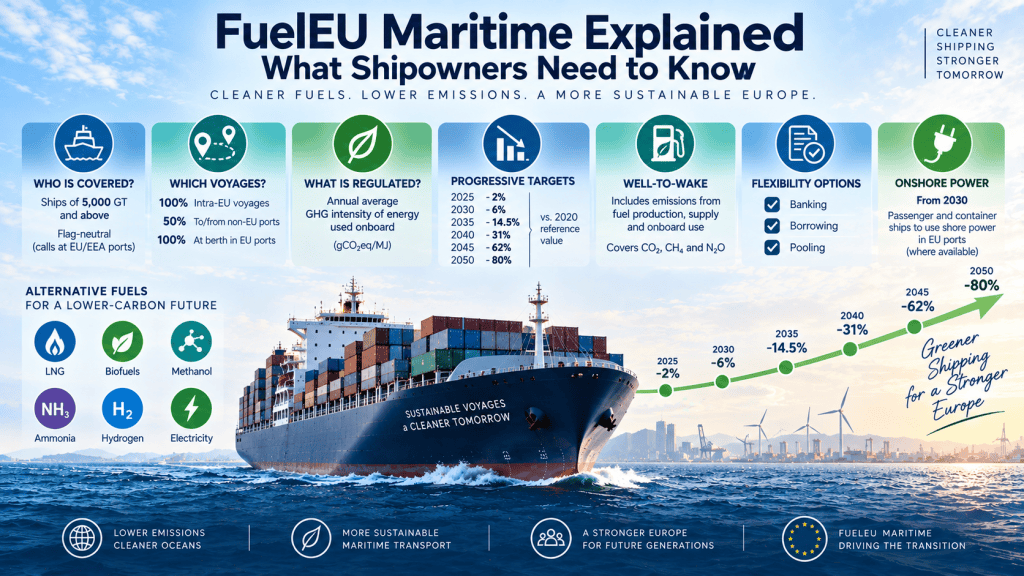
FuelEU Maritime has applied since 2025 and progressively reduces the permitted GHG intensity of energy used onboard ships within its scope.
Importantly, it uses a lifecycle approach.
This means:
Fossil Methanol ≠ Green Methanol
and
Fossil Ammonia ≠ Green Ammonia
The regulatory value of a fuel increasingly depends on how it was produced, not simply what it is called.
For shipowners trading in Europe, verified lifecycle GHG performance is therefore becoming an important commercial consideration.
9. Energy Efficiency Reduces the Alternative-Fuel Challenge
The discussion should not be limited to choosing between methanol and ammonia.
Another important question is:
How much fuel does the ship actually need?
Energy-saving technologies can reduce propulsion demand before the fuel is consumed.
These can include:
- Wind-Assisted Propulsion
- Air Lubrication Systems
- Hull and propeller optimisation
- Waste heat recovery
- Digital voyage optimisation
This creates a powerful relationship:
Lower energy demand → Less alternative fuel required → Lower operating cost
For example, a vessel using green methanol together with wind-assisted propulsion may require less expensive renewable fuel to complete the same voyage.
The same principle applies to green ammonia.
Therefore, future decarbonisation may involve a combination of:
Efficient Ship + Renewable Fuel + Energy-Saving Technology
rather than relying on the fuel alone.
10. Green Methanol vs Green Ammonia at a Glance
| Factor | Green Methanol | Green Ammonia |
|---|---|---|
| Carbon in molecule | Yes | No |
| Direct fuel-carbon CO₂ | Yes | No |
| Ambient condition | Liquid | Specialised storage required |
| Main safety concern | Flammability & toxicity | High toxicity & leakage |
| Renewable pathway | Bio / E-methanol | Renewable H₂-based ammonia |
| Carbon source required | Yes for e-methanol | No |
| Storage complexity | Comparatively lower | Higher |
| Marine experience | More developed | Emerging |
| Retrofit potential | Generally more practical | More challenging |
| Deep decarbonisation potential | High with sustainable pathway | Potentially very high with renewable production and emissions control |
The table is intentionally qualitative.
Actual performance depends on fuel-production pathway, engine technology, vessel design and operating profile.
11. Which Fuel Fits Which Ship?
There is no universal answer.
Green methanol may be attractive where shipowners prioritise:
- More practical liquid storage
- Existing marine experience
- Retrofit possibilities
- Earlier commercial deployment
Green ammonia may become attractive where:
- Very deep decarbonisation is required
- Renewable ammonia is available
- The vessel can accommodate specialised safety systems
- The operator can manage the additional safety and training requirements
Newbuild vessels have more flexibility because fuel tanks, machinery spaces and safety arrangements can be integrated from the beginning.
For existing vessels, conversion cost, remaining vessel life and available space become particularly important.
12. A Practical Fuel Selection Approach
Instead of asking which fuel is universally better, shipowners can evaluate six areas:
1. Lifecycle GHG Performance
What are the actual Well-to-Wake emissions?
2. Fuel Availability
Can renewable fuel be reliably supplied along the trading route?
3. Cost
What are the fuel, infrastructure and compliance costs?
4. Vessel Design
How much tank and equipment space is required?
5. Safety
What additional systems and crew procedures are necessary?
6. Future Regulations
Can the fuel pathway remain viable as GHG requirements become stricter?
This provides a more practical basis for comparing future marine fuels.
Conclusion
Green methanol and green ammonia both have significant potential in maritime decarbonisation.
Green methanol offers advantages in storage, handling and growing marine experience.
Green ammonia offers the important advantage of containing no carbon, giving it strong potential for deep decarbonisation when produced using renewable energy.
But neither fuel is automatically green.
Production pathway matters.
Lifecycle emissions matter.
Safety matters.
Availability and cost matter.
And perhaps most importantly:
Energy efficiency matters.
The future may therefore not produce one universal winning fuel.
Different ship types, routes and operating profiles may require different solutions.
For shipowners, the more useful question is:
“Which fuel pathway can provide the lowest practical lifecycle emissions and sustainable operating cost for this particular vessel?”


답글 남기기