Introduction
The transition to lower-emission shipping in Europe is being driven by more than one regulation.
While the EU Emissions Trading System places a carbon cost on greenhouse gas emissions, FuelEU Maritime takes a different approach.
It regulates the greenhouse gas intensity of the energy used onboard ships.
FuelEU Maritime has applied from 1 January 2025 and is designed to progressively increase the use of renewable and low-carbon energy in shipping.
The basic principle is:
Ships must progressively reduce the lifecycle GHG intensity of the energy they use.
This makes fuel production pathways, methane slip, renewable fuels, shore power and Well-to-Wake emissions increasingly important.
For shipowners, the regulation creates a new question:
It is no longer only how much fuel a ship consumes, but also how that fuel was produced and its lifecycle GHG intensity.
1. What Is FuelEU Maritime?
FuelEU Maritime is an EU regulation designed to promote the use of renewable and low-carbon fuels and clean energy technologies in maritime transport.
Rather than requiring ships to use one particular fuel or technology, the regulation is largely goal-based and technology-neutral.
Ship operators can therefore determine how they meet the required GHG-intensity limits according to their vessel type, operating profile and available technologies.
Possible solutions may include:
- Biofuels
- Renewable methanol
- Renewable hydrogen
- Renewable ammonia
- Synthetic fuels
- Electricity
- Onshore power
- Energy-efficiency improvements
The objective is not to mandate one future marine fuel.
Instead, FuelEU establishes increasingly stringent GHG-intensity requirements and allows the industry to determine how best to meet them.
2. Which Ships Are Covered?
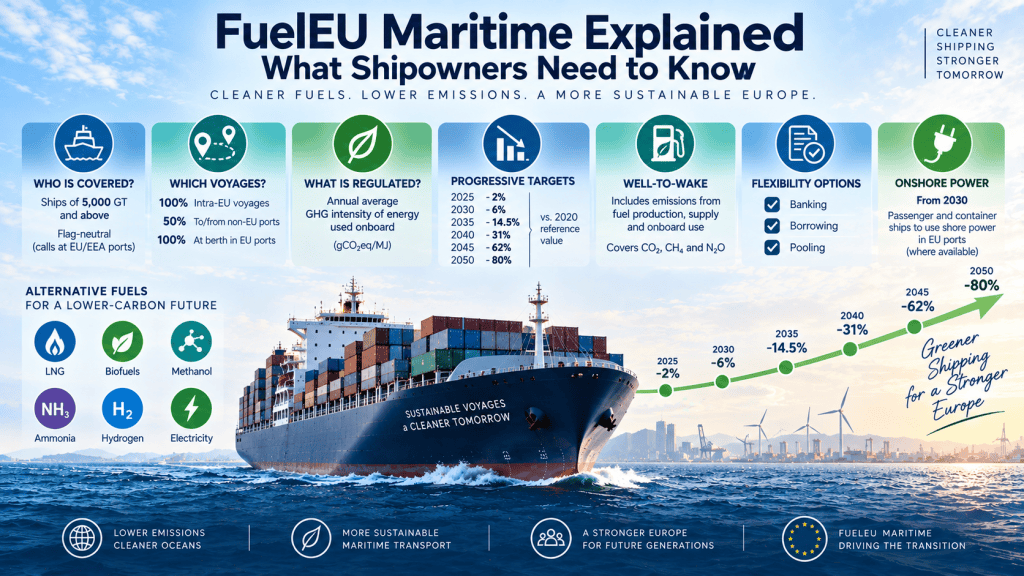
FuelEU Maritime generally applies to commercial ships above:
5,000 gross tonnage
calling at ports within its geographical scope, regardless of the ship’s flag.
This flag-neutral approach is important.
A vessel registered outside Europe can still fall within FuelEU Maritime when trading to European ports.
For example, a vessel sailing from Busan to Rotterdam may be affected even though it is not EU-flagged.
There are specific exemptions and special provisions, so individual vessel applicability should always be checked against the regulation.
3. Which Voyages Are Covered?
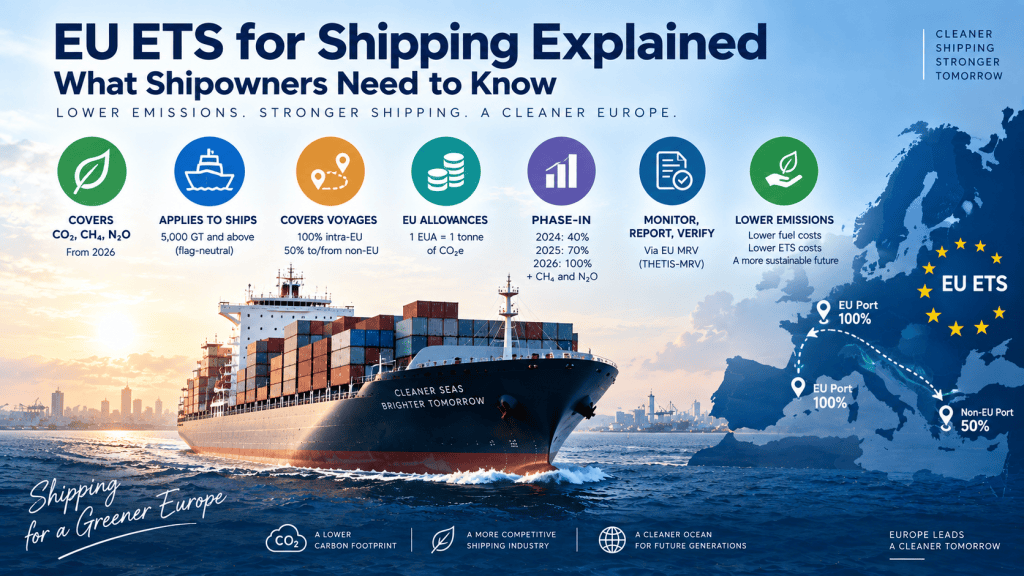
The geographical approach is broadly similar to the maritime EU ETS.
For voyages between ports within the applicable EU/EEA scope:
100% of the energy used is covered.
For voyages between an EU/EEA port and a third-country port:
50% of the energy used during the voyage is covered.
For energy used while the vessel is at berth within an applicable EU/EEA port:
100% is covered.
For example:
Rotterdam → Hamburg
100%
Busan → Rotterdam
50%
Rotterdam → Busan
50%
At berth in Rotterdam
100%
This means FuelEU Maritime can affect international vessels even when only part of their trading pattern involves Europe.
4. What Does FuelEU Actually Regulate?
This is the most important point.
FuelEU Maritime does not simply set a maximum amount of fuel that a vessel may consume.
Instead, it sets limits on the:
Annual average GHG intensity of the energy used onboard
The unit is expressed in terms of:
gCO₂eq/MJ
In simplified terms, this measures how much greenhouse gas is associated with each unit of energy used by the vessel.
A fuel with lower lifecycle greenhouse gas emissions can therefore improve the vessel’s FuelEU performance.
5. The Targets Become Progressively Stricter
FuelEU Maritime uses a 2020 reference value and progressively reduces the permitted annual average GHG intensity.
The required reductions are:
2025 → 2%
2030 → 6%
2035 → 14.5%
2040 → 31%
2045 → 62%
2050 → 80%
The progression is important.
The initial 2% reduction may appear relatively modest.
But the requirements become substantially more demanding after 2030.
Shipowners therefore need to consider not only whether a fuel strategy works today, but whether it can remain viable as the limits tighten.
6. FuelEU Uses Well-to-Wake Emissions
One of the most important characteristics of FuelEU Maritime is its use of a Well-to-Wake approach.
Well-to-Wake can be divided into:
Well-to-Tank + Tank-to-Wake = Well-to-Wake
Well-to-Tank
Covers emissions associated with producing and supplying the fuel.
This can include:
- Raw material extraction
- Fuel production
- Processing
- Transportation
- Distribution
Tank-to-Wake
Covers emissions associated with using the fuel onboard the vessel.
Together, these provide a broader lifecycle picture.
FuelEU covers CO₂, methane and nitrous oxide on this lifecycle basis.
7. Why Fuel Production Pathways Matter
Consider methanol.
A ship may technically use methanol, but the climate impact can differ substantially depending on how that methanol was produced.
Possible pathways include:
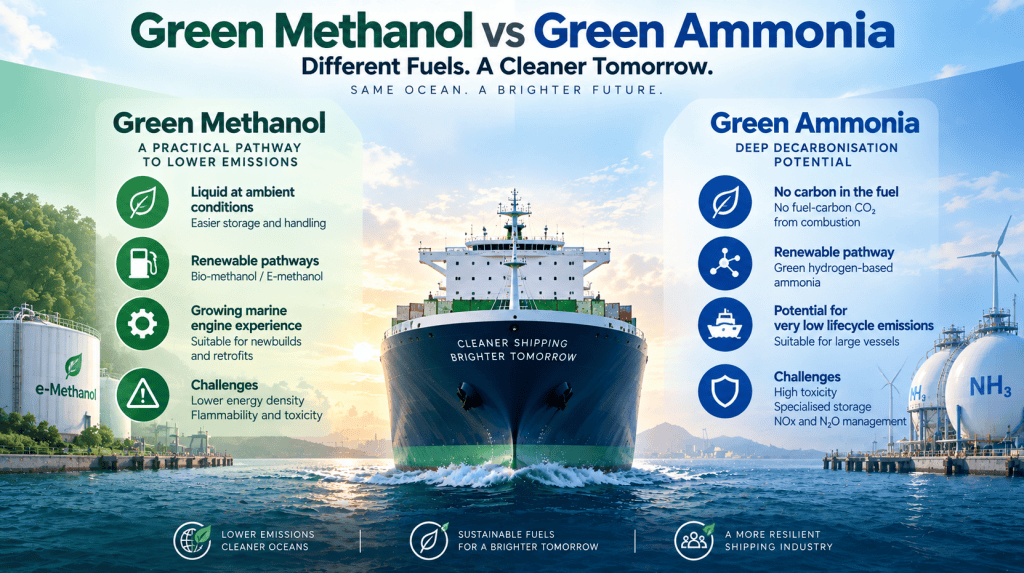
Fossil methanol
Bio-methanol
Renewable e-methanol
These fuels may be chemically similar when used onboard, but their upstream GHG emissions can differ significantly.
The same principle applies to hydrogen and ammonia.
For example:
Grey hydrogen is typically produced using fossil fuels without carbon capture.
Blue hydrogen generally involves fossil production combined with carbon capture.
Green hydrogen can be produced using renewable electricity.
Therefore:
Fuel name ≠ lifecycle GHG performance
The production pathway matters.
8. Why Methane Slip Matters
FuelEU does not consider CO₂ alone.
Methane (CH₄) and nitrous oxide (N₂O) are also included in its lifecycle GHG methodology.
This is particularly relevant to LNG-fuelled vessels.
Natural gas is primarily methane.
Some marine engines can release a proportion of unburned methane during operation, commonly referred to as:
Methane slip
Because methane is a potent greenhouse gas, methane slip can materially affect the lifecycle GHG performance of an LNG propulsion system.
The European Commission has consequently developed guidance for reporting and verifying actual Tank-to-Wake methane-slip emission factors under FuelEU Maritime.
This demonstrates why assessing only CO₂ emissions at the exhaust can provide an incomplete picture.
9. What About LNG?
LNG can provide advantages in reducing certain air pollutants and can reduce onboard CO₂ emissions compared with conventional marine fuels under some operating conditions.
However, FuelEU’s Well-to-Wake methodology means LNG must also be evaluated for:
- Upstream emissions
- Methane leakage
- Methane slip
- Engine technology
- Overall lifecycle GHG intensity
The future role of LNG therefore cannot be assessed solely on Tank-to-Wake CO₂ emissions.
Bio-LNG and synthetic renewable methane may offer different lifecycle characteristics from conventional fossil LNG.
Again, the production pathway becomes critical.
10. Methanol Under FuelEU Maritime
Methanol is attracting considerable interest as a marine fuel.
However, FuelEU makes an important distinction between different production pathways.
Fossil methanol does not have the same lifecycle GHG performance as renewable methanol.
Potential lower-GHG pathways include:
Bio-methanol
and
Renewable e-methanol
For shipowners considering methanol-fuelled vessels, long-term fuel procurement therefore becomes almost as important as engine selection.
A methanol-capable ship alone does not guarantee low lifecycle emissions.
The sustainability characteristics of the methanol supplied to that vessel are fundamental.
11. Ammonia and Hydrogen
Ammonia and hydrogen contain no carbon in their molecules.
That means their onboard use can potentially avoid direct CO₂ emissions from the fuel itself.
However:
Zero carbon in the molecule does not automatically mean zero lifecycle GHG emissions.
If hydrogen is produced using fossil energy, substantial upstream emissions may occur.
The same applies to ammonia because hydrogen is a major input to ammonia production.
Renewable production pathways therefore become particularly important.
Additional non-CO₂ emissions must also be considered depending on the technology.
For ammonia, for example, N₂O emissions can be relevant to overall GHG performance.
12. Renewable Fuels of Non-Biological Origin
FuelEU Maritime also provides incentives related to:
Renewable Fuels of Non-Biological Origin — RFNBOs
These can include renewable synthetic fuels produced using renewable hydrogen.
Examples may include:
- E-methanol
- E-ammonia
- Renewable hydrogen
RFNBOs are important because they could provide pathways towards much deeper lifecycle GHG reductions than conventional fossil fuels.
However, challenges remain regarding:
- Availability
- Production capacity
- Cost
- Renewable electricity supply
- Bunkering infrastructure
The regulatory direction may stimulate demand, but commercial availability will remain an important practical issue.
13. What Is a FuelEU Compliance Balance?
A ship’s annual GHG-intensity performance is compared with the applicable FuelEU limit.
This creates a:
Compliance balance
A vessel performing better than the required limit can generate a compliance surplus.
A vessel performing worse can have a compliance deficit.
FuelEU provides several flexibility mechanisms for managing these balances. EMSA’s current FuelEU systems include compliance-balance functionality within THETIS-MRV.
This is important because compliance does not necessarily have to be managed independently for every vessel in isolation.
14. Banking
If a ship generates a compliance surplus, FuelEU provides a mechanism allowing eligible surplus to be:
Banked
for future use.
This creates value for vessels that outperform the regulatory requirement.
Early investment in lower-GHG fuels or technologies can therefore potentially generate a compliance benefit that can be carried forward under the applicable rules.
15. Borrowing
FuelEU also provides limited flexibility through:
Borrowing
Under the applicable conditions, a ship may borrow an advance compliance surplus from the following reporting period to address a current deficit.
However, borrowing is subject to regulatory limitations and consequences.
It should therefore be viewed as a compliance flexibility mechanism rather than a permanent strategy for avoiding GHG-intensity improvements.
16. Pooling
Another important mechanism is:
Pooling
Ships can voluntarily pool their compliance balances.
The pool as a whole must satisfy the applicable GHG-intensity requirement.
This means a vessel performing significantly better than the FuelEU target may potentially help offset another vessel’s deficit within a compliant pool arrangement.
Conceptually:
Ship A → Surplus
Ship B → Deficit
Combined compliant pool → Potential compliance solution
Pooling could therefore influence fleet-level fuel and technology strategies.
Rather than requiring every ship to follow exactly the same decarbonisation pathway, companies may be able to optimise compliance across multiple vessels.
17. What Happens If a Ship Does Not Comply?
FuelEU includes financial penalties for compliance deficits that are not resolved through the permitted compliance mechanisms.
This means persistent reliance on high-GHG energy can have an increasing financial impact.
More importantly, the progressively tightening GHG-intensity limits mean that strategies that may satisfy the regulation during the early years may not necessarily remain sufficient later.
Shipowners therefore need to consider:
2025 compliance
but also:
2030, 2035 and longer-term compliance
when making newbuild, retrofit and fuel-contracting decisions.
18. Onshore Power Supply
FuelEU Maritime is not only about marine fuels.
It also introduces requirements relating to Onshore Power Supply (OPS).
From 1 January 2030, passenger ships and container ships covered by the relevant requirements will generally need to connect to shore-side electricity or use another qualifying zero-emission technology while moored at the quayside in specified EU ports.
From 2035, the requirement expands further to EU ports that have developed the relevant OPS capacity, subject to the detailed regulatory provisions and exceptions.
The objective is to reduce emissions from onboard power generation while vessels are in port.
Instead of operating auxiliary engines, vessels can obtain electricity from shore.
19. FuelEU Maritime vs EU ETS
FuelEU Maritime and EU ETS are complementary but fundamentally different.
EU ETS
Places a carbon cost on covered greenhouse gas emissions.
Conceptually:
More covered emissions → More EU Allowances required
FuelEU Maritime
Regulates the lifecycle GHG intensity of energy used onboard.
Conceptually:
Higher-GHG energy → Greater compliance challenge
A simplified distinction is:
EU ETS = Carbon pricing
FuelEU Maritime = Fuel and energy GHG-intensity regulation
Shipowners trading in Europe increasingly need to manage both simultaneously.
20. Energy Efficiency Still Matters
FuelEU primarily focuses on GHG intensity rather than simply total fuel consumption.
However, energy efficiency remains extremely important.
If a ship requires less energy to complete the same transport work, it needs less fuel.
Technologies may include:
- Wind-Assisted Propulsion
- Air Lubrication Systems
- Propeller optimisation
- Hull improvements
- Waste heat recovery
- Digital voyage optimisation
Reducing energy demand can make the transition to more expensive renewable fuels easier.
For example, imagine that renewable methanol costs significantly more than conventional fuel.
A ship requiring 10% less propulsion energy will also require less renewable fuel to perform the same voyage.
Therefore:
Energy efficiency reduces the amount of expensive low-GHG energy that must be purchased.
This may become one of the most important economic arguments for efficiency technologies.
21. WAPS and FuelEU Maritime
Wind-Assisted Propulsion Systems can provide propulsion energy from wind.
This can reduce the amount of fuel required by the main engine.
Under a lifecycle-based regulatory environment, renewable wind energy can therefore complement lower-GHG fuels.
Instead of thinking:
WAPS or alternative fuel
shipowners may increasingly consider:
WAPS + alternative fuel
For example, a vessel using renewable methanol combined with wind propulsion could potentially reduce the total quantity of renewable fuel required.
That can improve both emissions performance and operating economics.
22. Air Lubrication and FuelEU Maritime
Air Lubrication Systems reduce hull friction by supplying air beneath the vessel.
Unlike alternative fuels, ALS does not change the fuel itself.
Instead, it reduces the energy required to propel the ship.
This distinction is important.
FuelEU creates pressure to reduce the GHG intensity of energy.
Efficiency technologies reduce the amount of energy required.
The two approaches can therefore complement each other:
Lower energy demand × Lower-GHG energy = Greater overall decarbonisation
23. FuelEU Changes Fuel Procurement
Historically, bunker procurement focused heavily on:
- Fuel specification
- Availability
- Price
- Delivery location
FuelEU adds another increasingly important dimension:
Verified lifecycle GHG performance
Shipowners may therefore need reliable sustainability and fuel-certification information.
The commercial value of a fuel will increasingly depend not only on its price per tonne but also on:
Energy content + GHG intensity + Regulatory value
This could significantly change how future bunker contracts are structured.
24. FuelEU Is a Fleet Strategy
FuelEU should not necessarily be managed vessel by vessel.
Because mechanisms such as pooling and banking exist, companies can increasingly consider compliance at fleet level.
For example:
One vessel may use conventional fuel.
Another may use biofuel.
A third may operate on renewable methanol.
A fourth may achieve particularly strong performance through energy-saving technologies.
The company can then evaluate how these vessels interact within its wider compliance strategy.
This could make fleet optimisation an increasingly important part of maritime decarbonisation.
25. What Should Shipowners Do?
A practical FuelEU strategy should begin with understanding the current fleet.
Shipowners should consider:
- Which vessels are within scope?
- Which voyages are covered?
- What fuels are currently used?
- What is their Well-to-Wake GHG intensity?
- Where are the largest compliance deficits likely to occur?
- Which vessels could generate surpluses?
- Can banking or pooling support the fleet strategy?
- Which alternative fuels are commercially available?
- Which efficiency technologies can reduce energy demand?
- What will happen as the targets tighten after 2030?
The objective should not simply be:
“How do we comply this year?”
A better strategic question is:
“How do we build a fleet that can remain compliant as the GHG-intensity limits become progressively stricter?”
Conclusion
FuelEU Maritime represents an important change in the way shipping emissions are regulated.
The focus is shifting from simply measuring fuel consumption or exhaust CO₂ towards understanding the full lifecycle GHG intensity of marine energy.
The regulatory pathway is clear:
2025 → 2% reduction
2030 → 6%
2035 → 14.5%
2040 → 31%
2045 → 62%
2050 → 80%
This progressively changes the economics of marine fuels.
Fossil fuel, biofuel, e-methanol, ammonia, hydrogen and electricity cannot be evaluated only by their purchase price or onboard emissions.
Their production pathway and lifecycle GHG performance increasingly matter.
At the same time, FuelEU should not be viewed purely as a fuel regulation.
Energy efficiency can reduce the quantity of low-GHG energy a vessel needs.
That means technologies such as wind-assisted propulsion, air lubrication, hull optimisation and digitalisation can complement the transition to renewable fuels.
For shipowners, the long-term strategy may therefore be summarised as:
Use less energy.
Use lower-GHG energy.
Measure lifecycle emissions accurately.
Optimise compliance across the fleet.
That combination is likely to become increasingly important as FuelEU Maritime moves towards much deeper GHG-intensity reductions.


댓글 남기기