Introduction
Hydrogen is attracting increasing attention as the maritime industry explores new energy sources capable of supporting the transition towards lower- and zero-GHG shipping. Because hydrogen contains no carbon, its use in fuel cells or combustion systems can eliminate direct CO₂ emissions from the hydrogen itself.
However, hydrogen also presents significant challenges. Its low volumetric energy density, demanding storage requirements, safety considerations, production cost and limited bunkering infrastructure can make large-scale marine applications difficult.
Most importantly, the environmental benefit of hydrogen depends strongly on how it is produced. For hydrogen to make a meaningful contribution to maritime decarbonisation, the entire fuel lifecycle needs to be considered.
1. What Is Hydrogen?
Hydrogen is the lightest chemical element and can be used as an energy carrier in several different ways.
In maritime applications, hydrogen can potentially be used in internal combustion engines or converted into electricity through fuel cells. It can also serve as an important building block for producing hydrogen-derived fuels such as ammonia, methanol and synthetic fuels.
Hydrogen does not contain carbon. Therefore, when pure hydrogen is used, there are no direct CO₂ emissions from the hydrogen itself.
This characteristic makes hydrogen attractive from a decarbonisation perspective, but its overall climate impact depends heavily on its production pathway.
2. Different Types of Hydrogen
Hydrogen is often described using colours that indicate different production pathways.
Grey hydrogen is generally produced from fossil fuels such as natural gas without carbon capture. Although the hydrogen itself contains no carbon, its production can generate significant greenhouse gas emissions.
Blue hydrogen is also generally produced from fossil fuels, but carbon capture and storage is used to reduce some of the CO₂ emissions associated with production. Its lifecycle performance depends on factors including capture rates and upstream emissions.
Green hydrogen is produced through electrolysis of water using renewable electricity. When the electricity comes from low-GHG renewable sources, green hydrogen has the potential to achieve much lower lifecycle greenhouse gas emissions.
For shipping, the distinction between these production pathways is critical when evaluating hydrogen as a future low-GHG energy source.
3. Key Advantages of Hydrogen as a Marine Fuel
One of hydrogen’s most important advantages is that it contains no carbon. This means that direct CO₂ emissions from the hydrogen itself can be avoided when it is used onboard.
Hydrogen can also be used in fuel cells to generate electricity electrochemically rather than through conventional combustion. Fuel-cell systems can offer quiet operation and high efficiency, particularly for certain vessel operating profiles.
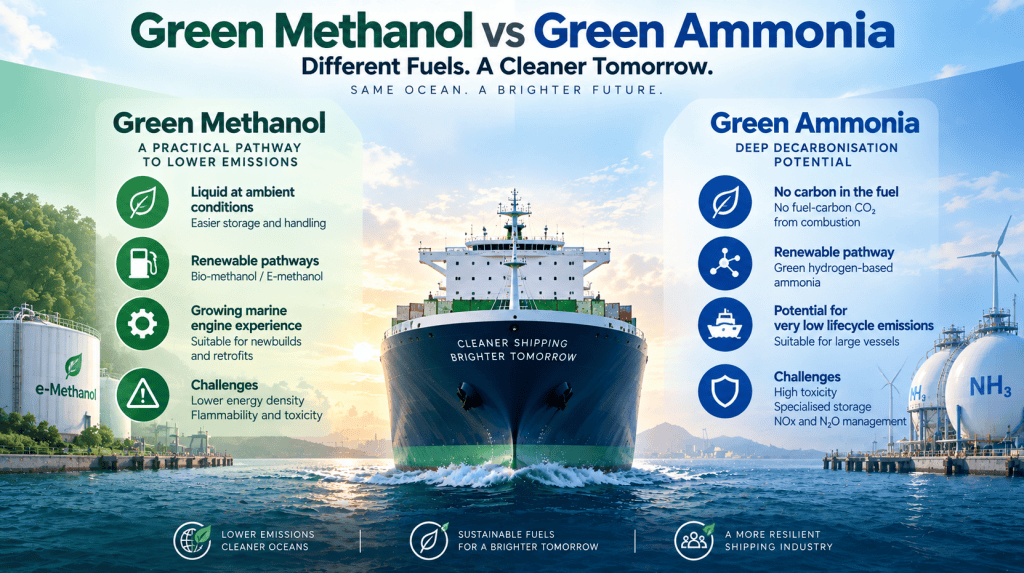
Another important advantage is hydrogen’s role beyond direct propulsion. Renewable hydrogen can be used to produce other potential marine fuels, including green ammonia and e-methanol.
Hydrogen may therefore play an important role in maritime decarbonisation even if direct hydrogen propulsion is not suitable for every type of vessel.
4. The Challenge of Hydrogen Storage
Storage is one of the biggest technical challenges associated with hydrogen.
Although hydrogen has high energy content by mass, its volumetric energy density is very low. Large storage volumes can therefore be required to carry sufficient energy onboard a vessel.
Compressed hydrogen requires high-pressure storage tanks, while liquid hydrogen needs to be maintained at extremely low cryogenic temperatures of approximately -253°C.
These requirements can significantly affect vessel design, tank arrangement, cargo capacity and overall system complexity.
For deep-sea vessels requiring large quantities of fuel for long voyages, these storage challenges can be particularly significant.
5. Safety Considerations
Hydrogen requires careful safety management because of its physical characteristics.
It is highly flammable, has a wide flammability range and can ignite with relatively low ignition energy. Hydrogen molecules are also extremely small, which means that preventing and detecting leakage is an important consideration.
Vessel designs therefore require appropriate ventilation, gas detection, hazardous-area management, isolation arrangements and emergency-response systems.
The regulatory framework is also developing. IMO adopted interim guidelines for the safety of ships using hydrogen as fuel in May 2026, providing an important foundation for the design and operation of future hydrogen-fuelled vessels.
6. Hydrogen Fuel Cells
Fuel cells are one of the most promising technologies for using hydrogen onboard ships.
Instead of burning fuel, a fuel cell converts chemical energy directly into electrical energy. The electricity can then be used to power electric propulsion motors and onboard equipment.
When pure hydrogen is used in certain fuel-cell systems, water is the principal reaction product at the point of use.
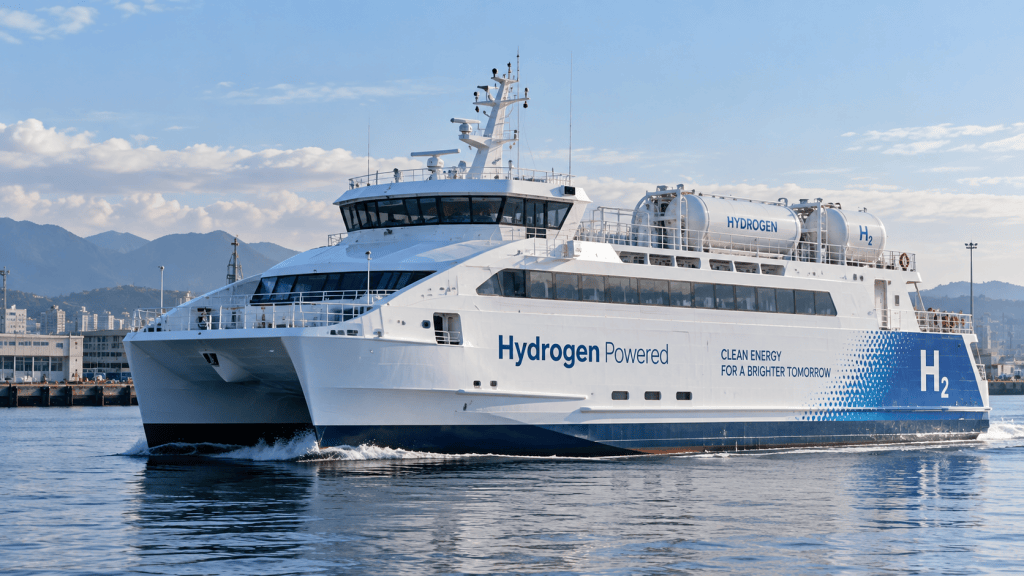
Fuel cells may be particularly attractive for ferries, coastal vessels, offshore vessels and other ships operating on routes where regular access to hydrogen bunkering infrastructure can be established.
For large deep-sea vessels, however, hydrogen storage volume and infrastructure requirements remain major challenges.
7. Hydrogen Combustion Engines
Hydrogen can also potentially be used in internal combustion engines.
This approach may allow the maritime industry to build on existing engine technology and manufacturing experience. However, hydrogen combustion is technically different from conventional fuel combustion and requires appropriately designed engines and fuel systems.
Although hydrogen contains no carbon, combustion can still produce nitrogen oxides (NOx) under certain conditions.
Consequently, engine optimisation and emissions-control technologies may still be necessary.
8. Lifecycle Emissions: Why Production Matters
Hydrogen should not automatically be described as a zero-GHG fuel simply because it produces no CO₂ from the hydrogen itself during onboard use.
If hydrogen is produced using fossil energy without effective emissions reduction measures, significant greenhouse gas emissions can occur during production.
By contrast, hydrogen produced through electrolysis using renewable electricity can potentially achieve much lower lifecycle emissions.
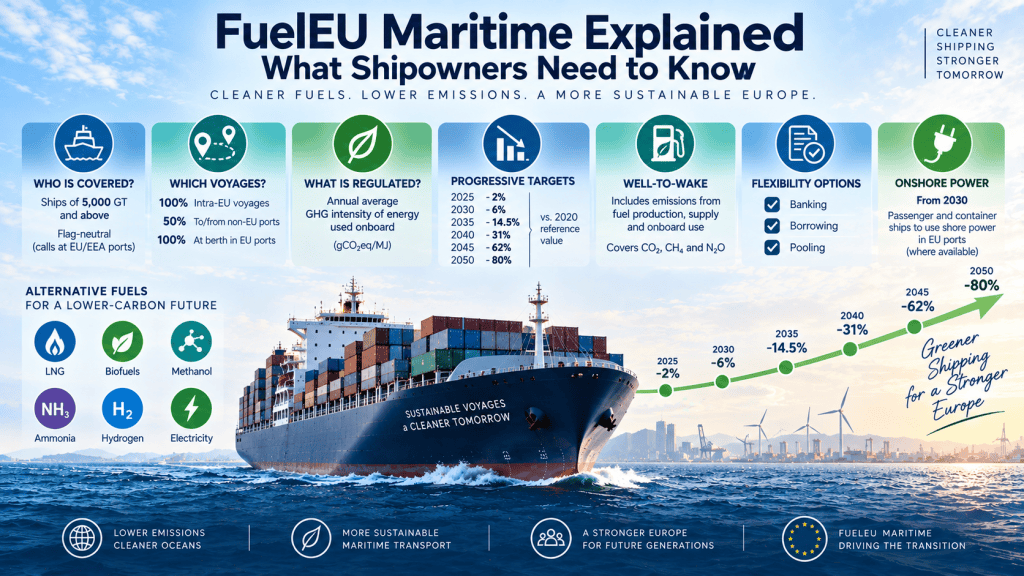
This is why a Well-to-Wake approach is increasingly important. IMO’s lifecycle framework considers emissions associated with fuel production, transportation and final use onboard the vessel rather than assessing only the ship’s exhaust emissions.
9. Infrastructure and Cost
Large-scale adoption of hydrogen in shipping would require significant development of production, transportation, storage and bunkering infrastructure.
Green hydrogen production also requires substantial quantities of renewable electricity. Increasing production capacity while reducing cost will therefore be essential if renewable hydrogen is to become commercially competitive.
Ports considering hydrogen bunkering will need specialised infrastructure and safety arrangements.
IMO and partner organisations are studying the renewable-fuel production and infrastructure required for net-zero shipping, reflecting the scale of the challenge facing the maritime energy transition.
10. Where Could Hydrogen Be Used First?
Direct hydrogen propulsion may initially be more suitable for vessels operating relatively short and predictable routes.
Ferries, harbour vessels, coastal ships and certain offshore vessels may have advantages because they can return regularly to locations where dedicated hydrogen infrastructure is available.
For long-distance ocean-going vessels, the storage requirements of hydrogen can be more challenging.
Hydrogen-derived fuels such as ammonia or e-methanol may therefore offer an alternative way of using renewable hydrogen energy for deep-sea shipping.
The future maritime energy system could consequently involve both direct hydrogen use and hydrogen converted into other marine fuels.
11. The Future Potential of Hydrogen in Shipping
Hydrogen is unlikely to become the universal fuel for every vessel type.
Instead, its role will probably depend on vessel size, operating profile, sailing distance, available storage space, bunkering infrastructure and the cost and availability of low-GHG hydrogen.
Its importance may extend well beyond vessels that directly carry hydrogen onboard. As a key feedstock for green ammonia, e-methanol and other synthetic fuels, hydrogen could become one of the fundamental building blocks of the future maritime energy system.
IMO itself identifies hydrogen, ammonia, methanol, biofuels, fuel cells, electricity and other technologies among the potential future options for shipping.
Conclusion
Hydrogen offers significant potential for maritime decarbonisation because it contains no carbon and can be used both directly as a marine energy source and indirectly to produce other low-GHG fuels.
However, important challenges remain. Storage volume, cryogenic or high-pressure systems, safety, infrastructure, renewable electricity availability and production cost will all influence the scale and speed of adoption.
The environmental benefits of hydrogen also depend strongly on its production pathway. Renewable hydrogen produced using low-GHG electricity can offer substantially greater lifecycle benefits than hydrogen produced from unabated fossil fuels.
For some short-sea and specialised vessels, direct hydrogen propulsion may become increasingly practical. For deep-sea shipping, hydrogen may ultimately have an equally important role as the building block for fuels such as green ammonia and e-methanol.


답글 남기기