Introduction
As the shipping industry works to reduce fuel consumption and greenhouse gas emissions, shipowners are increasingly considering energy-saving technologies that can improve vessel efficiency without requiring a complete change of fuel.
Two technologies attracting significant attention are Wind-Assisted Propulsion Systems (WAPS) and Air Lubrication Systems (ALS).
Both technologies aim to reduce the propulsion power required by a vessel, but they achieve this in very different ways.
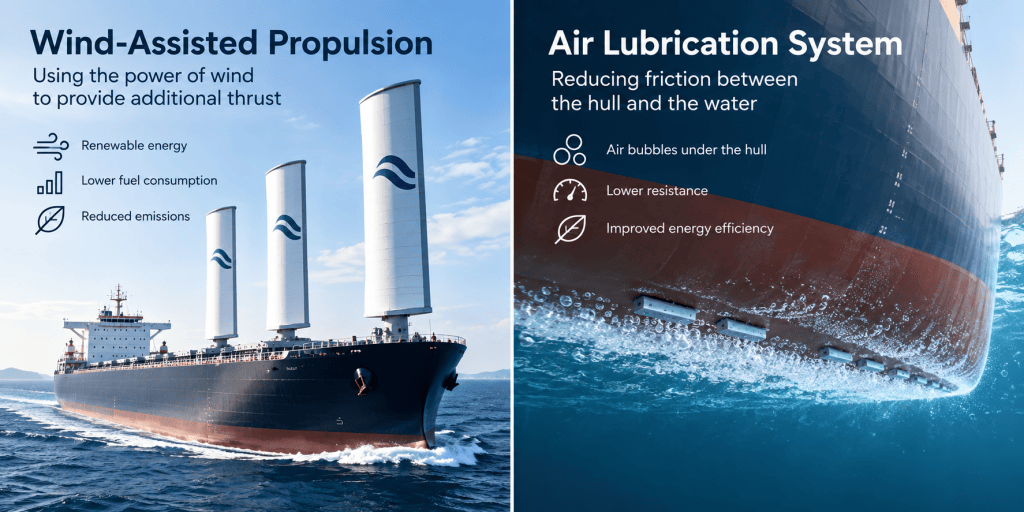
Wind-assisted propulsion uses the power of the wind to provide additional thrust, while air lubrication reduces friction between the ship’s hull and the surrounding water.
So which technology can save more energy?
The answer depends on the vessel type, operating profile, route, weather conditions and system design.
This article compares the two technologies and examines where each may provide the greatest benefit.
1. What Is Wind-Assisted Propulsion?
Wind-Assisted Propulsion Systems use wind energy to provide additional propulsion to a vessel.
Modern systems are very different from the traditional sails used by historical sailing ships. They are typically automated systems designed to operate alongside the vessel’s conventional propulsion system.
Common WAPS technologies include:
- Rotor sails
- Suction sails
- Wing sails
- Rigid sails
- Kite systems
When favourable wind conditions are available, these systems generate aerodynamic forces that help propel the vessel.
As a result, the main engine can operate at a lower power output while maintaining the required vessel speed.
This can reduce fuel consumption and associated greenhouse gas emissions.
2. What Is an Air Lubrication System?
An Air Lubrication System takes a completely different approach.
Instead of generating additional propulsion, ALS aims to reduce the resistance acting on the ship.
Air is supplied beneath the vessel and distributed across part of the underwater hull surface.
Depending on the system design, this can create a layer or distribution of air bubbles between the hull and the surrounding seawater.
The resulting reduction in frictional resistance can reduce the propulsion power required to maintain the vessel’s speed.
However, the system itself requires energy to generate and distribute the air, so the overall benefit must be evaluated on a net-energy basis.
3. The Fundamental Difference
The easiest way to understand the difference between WAPS and ALS is to consider how they reduce the load on the main propulsion system.
Wind-Assisted Propulsion:
Uses an external renewable energy source — wind — to generate additional propulsive force.
Air Lubrication:
Uses onboard energy to reduce frictional resistance between the hull and the water.
Both can reduce the power demanded from the main engine, but the physical principles are fundamentally different.
This difference is important when comparing their potential energy savings.
4. How Much Energy Can Wind-Assisted Propulsion Save?
There is no single fuel-saving percentage that applies to every vessel equipped with WAPS.
Performance depends heavily on factors such as:
- Wind speed and direction
- Vessel route
- Vessel speed
- Number and size of sails
- Available deck area
- Vessel aerodynamic characteristics
- Weather routing
- Operational profile
On routes with favourable wind conditions, the contribution from wind propulsion can become significant.
On routes with poor wind conditions, however, the benefit may be considerably lower.
This means that route analysis and vessel-specific performance modelling are particularly important when evaluating WAPS.
5. How Much Energy Can Air Lubrication Save?
ALS performance also varies significantly between vessels.
Potential savings depend on factors including:
- Hull form
- Vessel size
- Draft
- Vessel speed
- Air distribution
- Hull surface condition
- Compressor or blower efficiency
- Sea conditions
- System configuration
A key consideration is the energy required to operate the air supply equipment.
For this reason, gross resistance reduction should not be confused with net energy savings.
The most important figure for a shipowner is the reduction in total vessel fuel or energy consumption after the power consumed by the ALS equipment has been taken into account.
6. Which Technology Is More Consistent?
One potential advantage of ALS is that its operation is less directly dependent on wind availability.
If the vessel is operating within the appropriate design conditions, the system can potentially provide benefits across a wide range of routes.
WAPS is more dependent on environmental conditions.
Wind direction and speed can change considerably during a voyage, meaning the contribution from wind propulsion will also vary.
However, modern weather routing and voyage optimisation can help vessels identify routes and operating strategies that make better use of available wind energy.
Therefore, consistency and maximum potential savings are not necessarily the same thing.
7. Vessel Type Matters
Neither technology is equally suitable for every ship.
WAPS may be particularly attractive for vessels with sufficient deck space and operating profiles that provide favourable wind conditions.
Potential applications include:
- Bulk carriers
- Tankers
- RoRo vessels
- General cargo ships
- Some passenger and specialised vessels
ALS can be attractive for vessels where frictional resistance represents a significant part of total resistance and where the underwater hull geometry is suitable for effective air distribution.
Applications may include:
- Large container ships
- Cruise ships
- LNG carriers
- RoRo and RoPax vessels
- Other large merchant vessels
However, suitability must always be assessed on a vessel-specific basis.
8. Retrofit Considerations
Both technologies can potentially be applied to existing ships, but retrofit complexity can differ substantially.
For WAPS, engineers may need to consider:
- Foundation strength
- Deck reinforcement
- Visibility requirements
- Cargo-handling interference
- Bridge clearance
- Electrical and hydraulic connections
- Stability
- Air draft
ALS retrofit considerations may include:
- Hull modifications
- Air release units
- Compressor or blower installation
- Machinery-space availability
- Electrical power demand
- Piping arrangements
- Dry-docking requirements
The technical feasibility of a retrofit can therefore be just as important as the theoretical energy-saving potential.
9. Maintenance and Operational Considerations
Energy savings alone should not determine technology selection.
Shipowners must also consider lifecycle cost and operational reliability.
WAPS may introduce additional deck equipment, structural loads and control systems.
Depending on the technology, maintenance requirements can vary significantly.
ALS introduces air supply equipment, piping and underwater air distribution components.
The condition of these components, together with hull fouling and system efficiency, can influence long-term performance.
Therefore, technologies should ideally be evaluated based on total cost of ownership rather than fuel savings alone.
10. Can WAPS and ALS Be Used Together?
Yes.
WAPS and ALS do not necessarily compete with each other.
Because they address different components of vessel efficiency, they may potentially be combined.
For example, a vessel could use wind propulsion to generate additional thrust while simultaneously using air lubrication to reduce hull friction.
Other efficiency measures could also be integrated, including:
- Advanced hull coatings
- Propeller optimisation
- Energy-saving devices
- Waste heat recovery
- Voyage optimisation
- Speed optimisation
This combination approach may become increasingly important as shipowners seek deeper reductions in fuel consumption and emissions.
11. Which Saves More Energy?
There is no universal winner.
For a vessel operating regularly in favourable wind conditions, a well-designed WAPS installation may provide substantial savings because part of the propulsion energy is supplied directly by wind.
For another vessel with different routes, hull characteristics or operating conditions, ALS may provide more predictable efficiency improvements.
The correct comparison therefore should not simply be:
“Which technology has the highest advertised saving?”
A better question is:
“Which technology delivers the greatest verified net energy saving over this vessel’s actual operating profile?”
This requires vessel-specific analysis using realistic operational data.
12. The Importance of Combining Technologies
The future of maritime efficiency is unlikely to depend on one technology alone.
Decarbonising existing ships may require several measures working together.
A vessel could potentially combine:
Wind propulsion + air lubrication + hull optimisation + propeller improvements + digital voyage optimisation
The cumulative effect may provide significantly greater efficiency improvements than relying on a single solution.
These technologies may also reduce the amount of expensive low-GHG fuel required in the future.
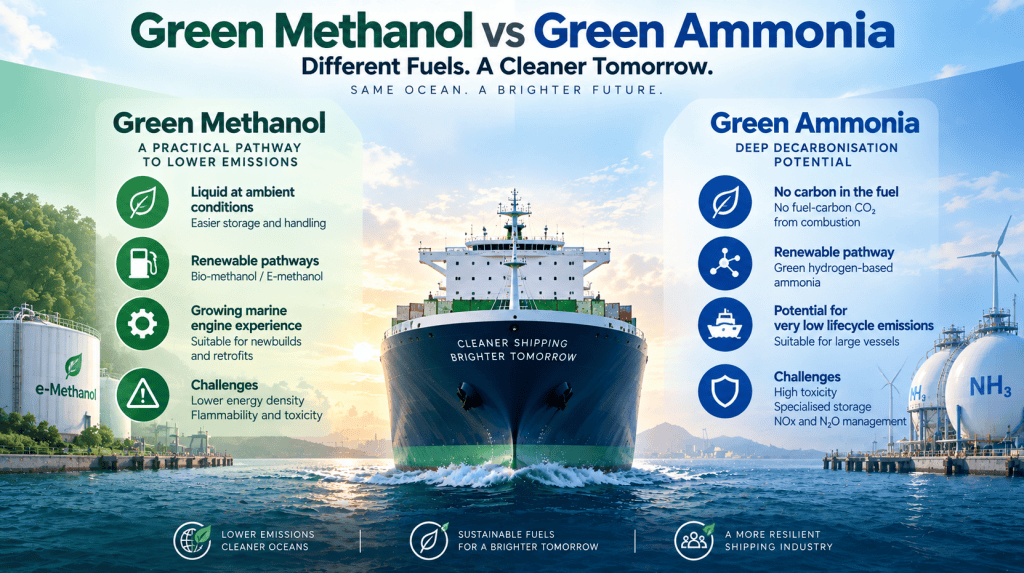
That could become increasingly important as shipping transitions towards fuels such as green methanol, ammonia and hydrogen-derived fuels.
Conclusion
Wind-Assisted Propulsion Systems and Air Lubrication Systems represent two very different approaches to improving ship efficiency.
WAPS uses renewable wind energy to provide additional propulsion, while ALS reduces the frictional resistance acting on the vessel’s hull.
Neither technology can be declared universally superior.
Actual performance depends on vessel design, route, operating conditions, system efficiency and installation configuration.
For shipowners, the most meaningful comparison is therefore not the maximum theoretical saving but the net lifecycle benefit under real operating conditions.
As maritime decarbonisation requirements become more demanding, combinations of energy-saving technologies may become increasingly important.
The most efficient ships of the future may not rely on a single solution, but instead integrate multiple technologies to reduce energy demand before considering how that remaining energy is produced.



답글 남기기