Introduction
As shipping moves towards decarbonisation, comparing marine fuels is becoming increasingly complex.
Traditionally, attention has focused mainly on emissions produced onboard a vessel when fuel is consumed. However, this approach does not show the full environmental impact of a fuel.
A fuel may produce relatively low emissions onboard but require significant energy or generate substantial greenhouse gas emissions during production, processing and transportation.
For this reason, the maritime industry is increasingly using a lifecycle approach known as Well-to-Wake.
Understanding Well-to-Wake emissions is essential for evaluating LNG, methanol, ammonia, hydrogen, biofuels and other alternative marine fuels fairly.
1. What Does Well-to-Wake Mean?
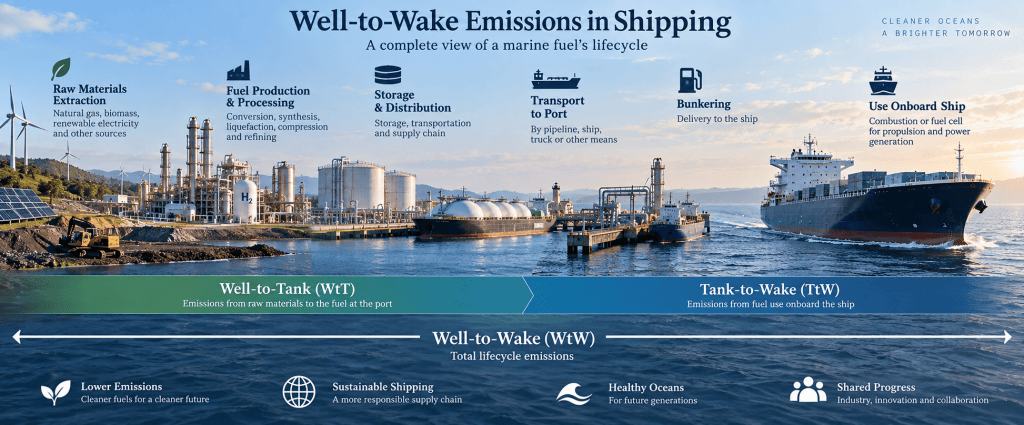
Well-to-Wake, commonly abbreviated as WtW, measures greenhouse gas emissions across the entire lifecycle of a fuel.
The concept can be divided into two main stages:
Well-to-Tank (WtT) covers emissions generated before the fuel reaches the vessel. This can include raw material extraction, fuel production, processing, transportation, storage and distribution.
Tank-to-Wake (TtW) covers emissions associated with using the fuel onboard the ship.
Together:
Well-to-Wake = Well-to-Tank + Tank-to-Wake
This lifecycle approach provides a more complete picture of the climate impact of different marine fuels.
2. Why Tank-to-Wake Is Not Enough
Looking only at emissions from the vessel can sometimes create a misleading impression.
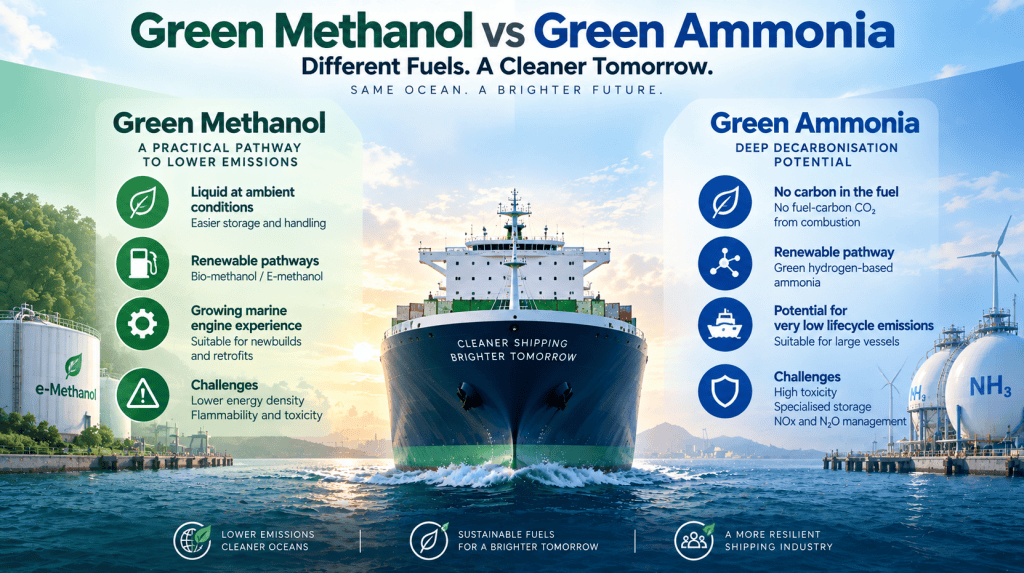
Hydrogen and ammonia, for example, contain no carbon. Therefore, the fuel itself does not produce CO₂ when used onboard in the same way as carbon-containing fuels.
However, producing hydrogen or ammonia can require substantial amounts of energy.
If that energy comes from fossil fuels, significant greenhouse gas emissions may occur before the fuel ever reaches the ship.
The same principle applies to other fuels.
The environmental performance of methanol depends strongly on whether it is produced from fossil feedstocks, biomass or renewable hydrogen and captured carbon.
Therefore, assessing only onboard emissions does not provide enough information to determine whether a fuel genuinely supports deep decarbonisation.
3. Well-to-Tank Emissions
Well-to-Tank emissions occur throughout the fuel supply chain.
Depending on the fuel, they can include emissions associated with:
- extraction or production of raw materials
- electricity generation
- hydrogen production
- fuel synthesis
- liquefaction or compression
- processing and refining
- transportation
- storage
- bunkering
For LNG, for example, upstream emissions may include natural gas extraction, methane leakage, processing, liquefaction and transportation.
For green hydrogen, electricity used for electrolysis is particularly important.
For e-methanol or green ammonia, the origin of the hydrogen and electricity used during production can have a major influence on overall lifecycle emissions.
4. Tank-to-Wake Emissions
Tank-to-Wake emissions occur when energy is used onboard the vessel.
For conventional fossil fuels, this includes CO₂ generated during combustion as well as other relevant emissions.
For LNG, CO₂ emissions from combustion are accompanied by the need to consider methane slip from certain engine technologies.
For ammonia combustion, direct CO₂ from the ammonia itself can be avoided, but emissions such as nitrous oxide and unburned ammonia require careful management.
Hydrogen can avoid direct CO₂ emissions from the hydrogen itself, but combustion-based applications may still require control of nitrogen oxide emissions.
Tank-to-Wake analysis therefore involves more than simply measuring CO₂.
5. Why Methane Matters
Methane is particularly important when assessing LNG on a Well-to-Wake basis.
Natural gas consists primarily of methane, which is a potent greenhouse gas.
Methane can escape during production, processing and transportation. It can also pass through some marine engines without being fully combusted, a phenomenon known as methane slip.
As a result, LNG may show an advantage when only direct CO₂ emissions are considered, while its overall lifecycle GHG performance can be less favourable when methane emissions are included.
Engine technology and upstream fuel supply therefore have a significant influence on the actual Well-to-Wake performance of LNG.
6. The Importance of Fuel Production Pathways
One of the most important lessons from lifecycle analysis is that the name of a fuel alone does not determine its environmental performance.
Consider methanol.
Fossil methanol, bio-methanol and e-methanol can all be used in similar marine engines, but their lifecycle GHG emissions may be very different.
The same applies to ammonia.
Conventional fossil-based ammonia can have substantial upstream emissions, while green ammonia produced using renewable hydrogen may offer much lower lifecycle emissions.
Hydrogen shows a similar pattern. Hydrogen produced from unabated fossil fuels has a very different emissions profile from renewable hydrogen produced through electrolysis using low-GHG electricity.
The question therefore needs to move from simply:
“What fuel does the ship use?”
to:
“How was that fuel produced?”
7. Well-to-Wake and IMO Regulation
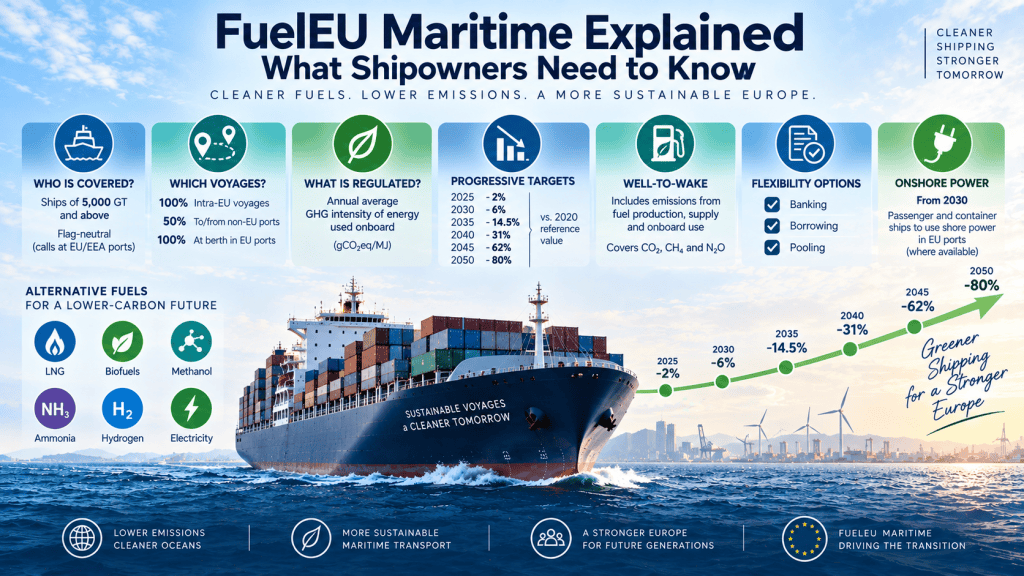
Lifecycle assessment is becoming increasingly important in international maritime regulation.
IMO’s 2023 Strategy on Reduction of GHG Emissions from Ships established a stronger pathway towards net-zero GHG emissions from international shipping by or around 2050.
IMO has also developed Lifecycle GHG Assessment Guidelines, providing a framework for assessing greenhouse gas emissions associated with marine fuels across their lifecycle.
This approach is important because future regulation needs to distinguish between fuels that may appear similar onboard but have very different upstream emissions.
IMO’s lifecycle methodology considers emissions from fuel production through to final use onboard the vessel.
8. How Different Marine Fuels Compare
There is no simple universal ranking of marine fuels because their lifecycle emissions depend on production pathways, technologies and supply chains.
Conventional marine fuels generally have substantial Tank-to-Wake CO₂ emissions because they contain fossil carbon.
LNG may reduce direct CO₂ emissions compared with conventional oil fuels, but methane leakage and methane slip can significantly influence lifecycle performance.
Methanol produces CO₂ when combusted because it contains carbon, but renewable or low-GHG production pathways can potentially reduce lifecycle emissions.
Ammonia contains no carbon and therefore avoids direct CO₂ emissions from the ammonia itself, but its lifecycle performance depends heavily on how hydrogen used in its production is produced.
Hydrogen also contains no carbon, but its environmental benefit depends strongly on the energy source and production method.
Biofuels can potentially achieve lower lifecycle emissions, but their performance depends on feedstock, production processes, land-use considerations and sustainability criteria.
This illustrates why lifecycle assessment is necessary when comparing future marine fuels.
9. Well-to-Wake and Shipowners
For shipowners, Well-to-Wake performance is becoming increasingly relevant to investment decisions.
A vessel ordered today may remain operational for 20 to 25 years or longer.
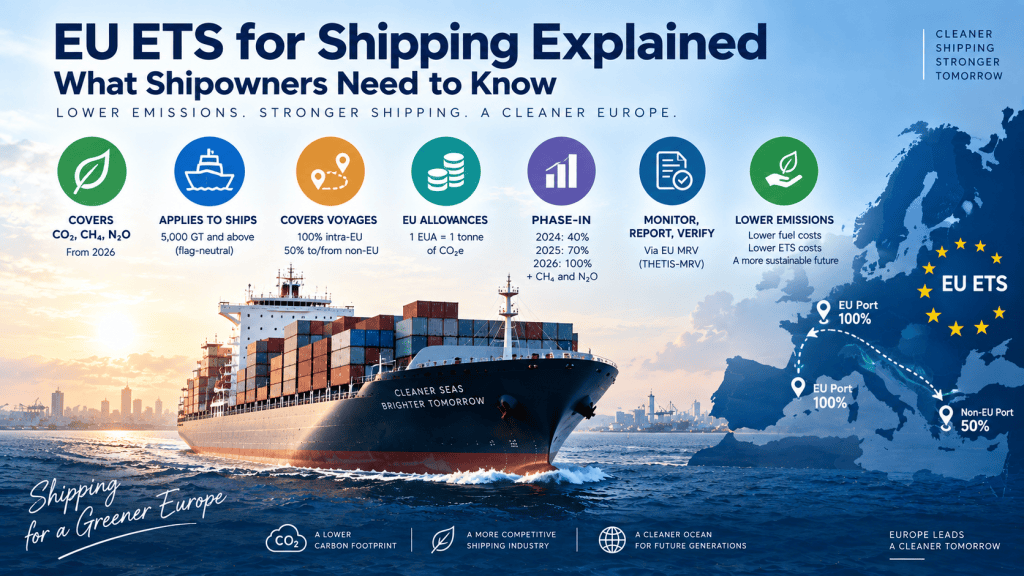
During that period, fuel regulations, carbon pricing mechanisms and fuel availability could change significantly.
Selecting an engine capable of using a particular alternative fuel is therefore only one part of the decision.
Shipowners increasingly need to consider:
- future availability of low-GHG fuel
- lifecycle GHG intensity
- fuel production pathway
- bunkering infrastructure
- engine efficiency
- methane or other non-CO₂ emissions
- future regulatory requirements
- potential carbon-related costs
Fuel flexibility may consequently become an important part of long-term vessel strategy.
10. Well-to-Wake Does Not Mean Fuel Alone
Another important point is that decarbonisation should not be considered only as a fuel-selection problem.
Reducing the amount of energy a vessel requires can reduce emissions regardless of which fuel is used.
Technologies such as wind-assisted propulsion, air lubrication systems, hull optimisation, propeller improvements, waste heat recovery and digital voyage optimisation can reduce fuel consumption.
If a future low-GHG fuel is expensive or limited in supply, improving vessel efficiency becomes even more valuable.
The future of green shipping will therefore likely involve a combination of low-GHG fuels and energy-efficiency technologies.
11. From Fuel Price to GHG Intensity
Historically, marine fuel decisions were largely influenced by fuel price, availability and engine compatibility.
In a decarbonising maritime industry, another factor is becoming increasingly important: GHG intensity.
Two fuels with similar market prices could create very different regulatory and environmental outcomes if their lifecycle emissions differ significantly.
Likewise, two batches of the same nominal fuel may have different lifecycle GHG intensities depending on how and where they were produced.
Fuel certification, traceability and lifecycle data may therefore become increasingly important parts of marine fuel procurement.
Conclusion
Well-to-Wake analysis changes the way the maritime industry evaluates alternative fuels.
Rather than focusing only on what comes out of a ship’s exhaust, it considers emissions across the entire energy chain — from production and processing to transportation and final use onboard.
This is particularly important for fuels such as LNG, methanol, ammonia and hydrogen, where production pathways can dramatically influence overall greenhouse gas performance.
There is therefore no simple answer to the question of which marine fuel is the cleanest.
The more important questions are how the fuel is produced, how efficiently it is used and what emissions occur across its entire lifecycle.
As maritime decarbonisation progresses, understanding Well-to-Wake emissions will become increasingly important for shipowners, shipbuilders, technology suppliers and fuel producers making long-term investment decisions.


답글 남기기