Introduction
The Carbon Intensity Indicator, commonly known as CII, has become an important part of the International Maritime Organization’s strategy to improve the operational efficiency of ships and reduce greenhouse gas emissions from international shipping.
Unlike design-based efficiency regulations, CII evaluates how efficiently a ship actually operates each year.
A vessel’s fuel consumption, distance travelled and transport capacity all influence its annual carbon intensity performance.
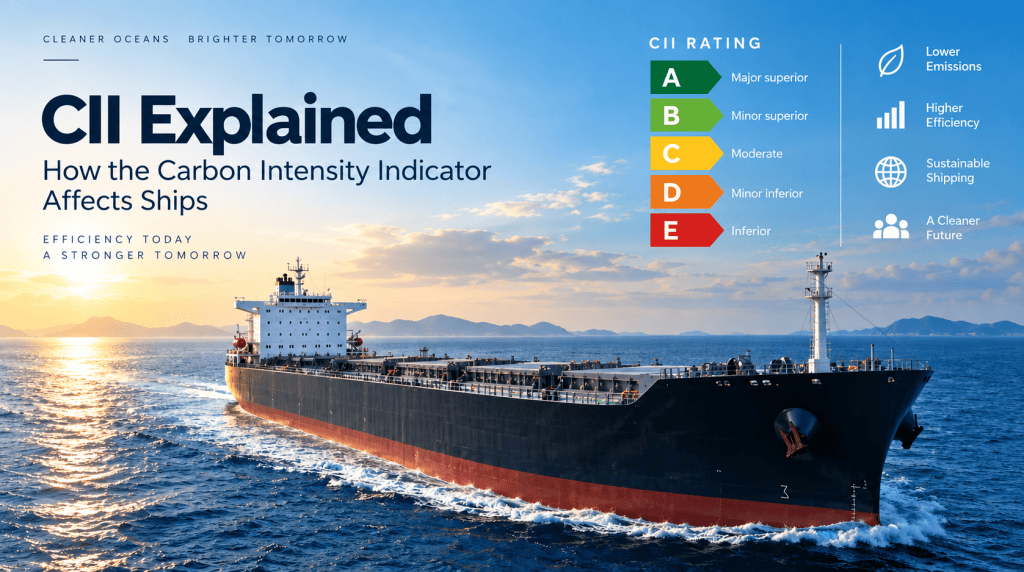
Ships receive a rating from A to E, with A representing the best performance. Poor ratings can require corrective action and may increasingly influence operational, commercial and investment decisions.
Understanding CII is therefore becoming important not only for shipowners and operators, but also for charterers, shipbuilders and technology suppliers.
1. What Is CII?
CII stands for Carbon Intensity Indicator.
It measures a ship’s annual operational carbon intensity by relating its CO₂ emissions to its transport work.
In simple terms, CII attempts to answer the question:
How efficiently does a ship transport its capacity over the distance it travels?
The IMO CII requirements apply to relevant ships of 5,000 gross tonnage and above that are subject to IMO fuel-consumption data collection requirements.
The system became mandatory from 1 January 2023, with the first annual ratings assigned in 2024 based on 2023 operational data.
2. How Is CII Calculated?
For many ship types, operational carbon intensity is expressed using the Annual Efficiency Ratio (AER).
In simplified terms:
CII ≈ Annual CO₂ Emissions ÷ (Ship Capacity × Distance Travelled)
Fuel consumption is converted into CO₂ emissions using the appropriate conversion factors.
The result is then compared with the required CII applicable to the vessel.
This means that CII performance can be influenced by several factors, including:
- fuel consumption
- sailing distance
- vessel capacity
- operating speed
- waiting and idle periods
- weather and routing
- hull and propeller condition
- machinery efficiency
CII is therefore not simply a measure of engine efficiency. It reflects the overall operational performance of the vessel during the year.
3. The CII Rating System: A to E
Each applicable ship receives an annual operational carbon-intensity rating.
The five ratings are:
A – Major superior
B – Minor superior
C – Moderate
D – Minor inferior
E – Inferior
A, B and C represent acceptable or better performance levels, while D and E indicate poorer carbon-intensity performance.
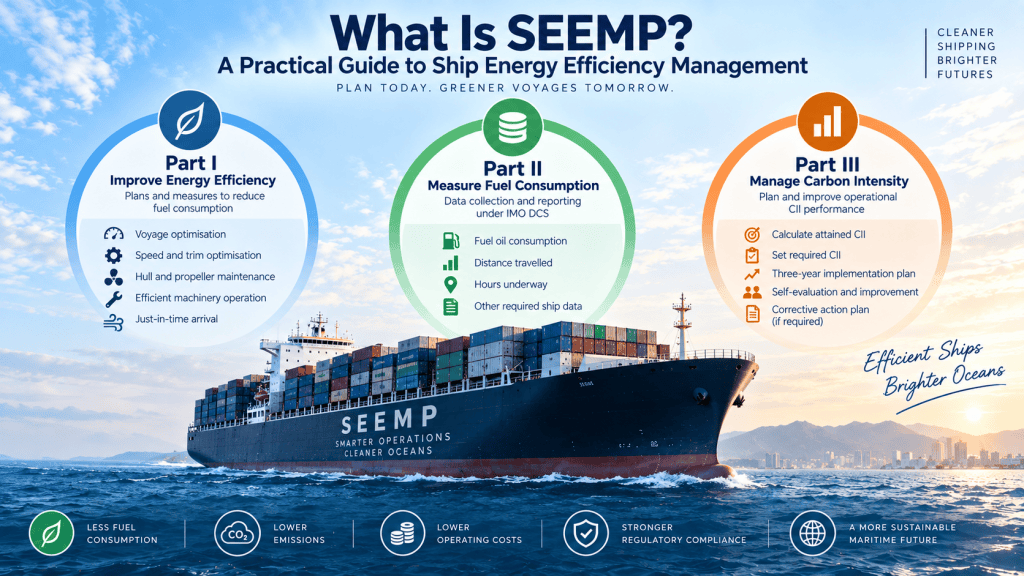
The rating is recorded in the vessel’s documentation and reflected through the Ship Energy Efficiency Management Plan, or SEEMP.
The objective is not simply to measure performance, but to encourage continuous improvement.
4. What Happens If a Ship Receives a Poor Rating?
A poor CII rating has regulatory consequences.
If a ship receives a D rating for three consecutive years, or an E rating for one year, a corrective action plan must be developed showing how the vessel will achieve the required rating of C or above.
The corrective measures will depend on the vessel and its operating profile.
Possible measures may include improving voyage planning, reducing speed, cleaning the hull, improving propeller condition, optimising machinery operation or installing energy-saving technologies.
IMO also encourages administrations, port authorities and other stakeholders to consider incentives for ships achieving A or B ratings.
5. Why Does CII Become More Difficult Over Time?
| Year | Reduction Factor |
|---|---|
| 2023 | 5% |
| 2024 | 7% |
| 2025 | 9% |
| 2026 | 11% |
| 2027 | 13.625% |
| 2028 | 16.250% |
| 2029 | 18.875% |
| 2030 | 21.500% |
These updated factors, including the requirements for 2027–2030, were adopted by IMO at MEPC 83 in April 2025.
This has an important practical implication.
A ship that achieves an acceptable CII rating today cannot assume that the same operational performance will remain sufficient in future years.
Continuous efficiency improvement becomes increasingly important.
6. How Can Ships Improve Their CII Rating?
There is no single solution suitable for every vessel.
In many cases, CII improvement will involve a combination of operational and technical measures.
Speed Optimisation
Reducing or optimising vessel speed can significantly reduce propulsion power demand and fuel consumption.
For many vessels, this can be one of the fastest ways to improve operational carbon intensity.
However, commercial schedules and charter-party requirements also need to be considered.
Hull and Propeller Maintenance
Hull fouling increases resistance and therefore fuel consumption.
Regular hull cleaning and maintaining good propeller condition can help reduce unnecessary energy consumption.
IMO specifically identifies hull cleaning and speed and route optimisation among measures that can improve CII performance.
Voyage and Route Optimisation
Weather routing, voyage optimisation and improved arrival planning can reduce unnecessary sailing, waiting and fuel consumption.
Digital technologies can increasingly support these decisions using vessel and weather data.
Energy-Saving Technologies
Technical solutions can also reduce propulsion energy demand.
Potential technologies include:
- wind-assisted propulsion
- air lubrication systems
- propeller and rudder improvements
- waste heat recovery
- advanced hull coatings
- machinery optimisation
The economic attractiveness of these technologies may increase as CII requirements become progressively stricter.
7. How Do Alternative Fuels Affect CII?
Fuel selection can also influence CII performance because different fuels have different CO₂ characteristics.
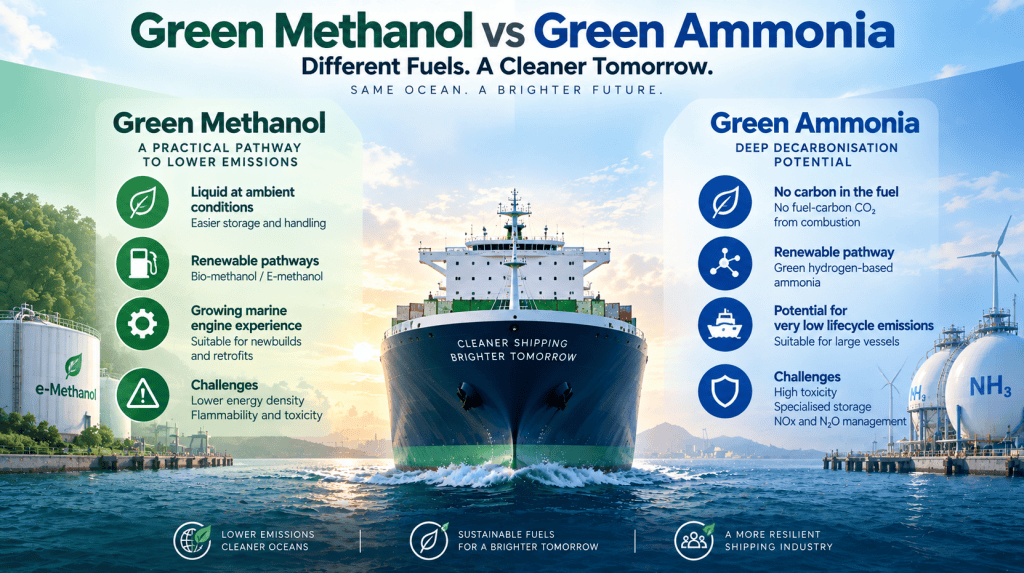
A ship using lower-carbon energy may potentially improve its operational carbon-intensity performance compared with a similar vessel using conventional fossil fuel. IMO also notes that low-carbon fuels can contribute to improved ratings.
However, CII should not be confused with a complete lifecycle GHG assessment.
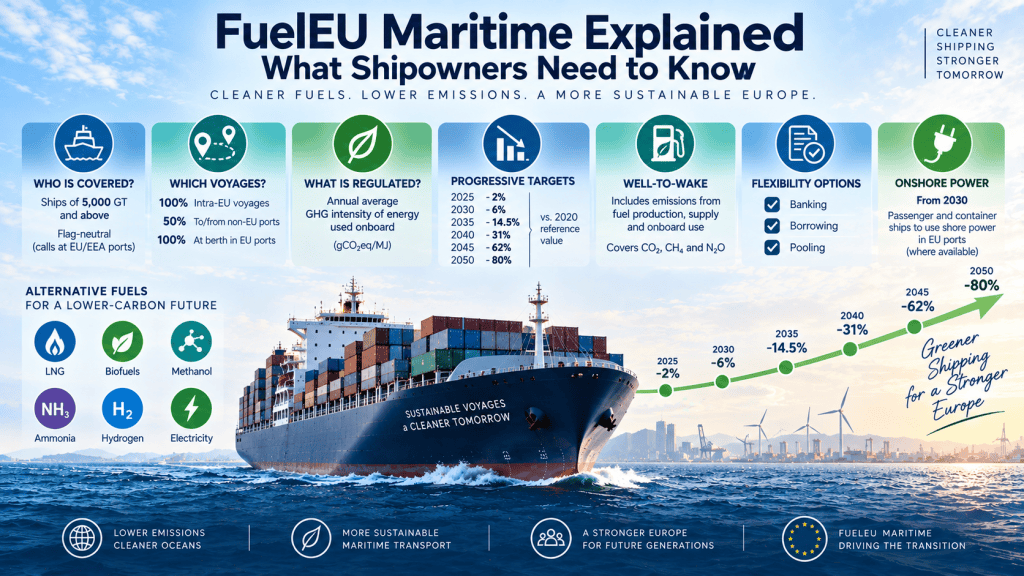
As discussed in our previous article on Well-to-Wake emissions, a fuel can have relatively low onboard CO₂ emissions while still generating significant emissions during production and transportation.
CII and Well-to-Wake analysis therefore address related but different aspects of maritime decarbonisation.
8. CII and Ship Operations
CII can influence the way ships are operated.
For example, a vessel operating inefficiently for extended periods may consume fuel without generating equivalent transport work, potentially affecting its annual performance.
Speed, routing, port waiting time, weather conditions and vessel utilisation can therefore become increasingly important considerations.
This also creates a challenge: not every factor affecting CII is entirely under the control of the shipowner.
Charterers, ports, cargo schedules and trading patterns can influence vessel operations.
As a result, CII is increasingly becoming a commercial as well as a technical issue.
9. CII and Older Ships
Older vessels may face greater challenges in maintaining acceptable CII ratings.
A ship with an older hull design, less efficient machinery or limited retrofit options may require greater operational changes to achieve the same carbon-intensity performance as a more efficient vessel.
Shipowners may therefore need to compare the cost of:
operational improvements → retrofit investment → alternative fuels → vessel replacement
For some vessels, relatively simple efficiency measures may be sufficient.
For others, maintaining competitive CII performance could eventually require more significant investment.
10. CII vs EEXI: What Is the Difference?
CII and EEXI are sometimes confused, but they measure different aspects of vessel efficiency.
EEXI – Energy Efficiency Existing Ship Index
EEXI primarily evaluates the vessel’s technical or design efficiency against a required standard.
CII – Carbon Intensity Indicator
CII evaluates the vessel’s actual annual operational carbon intensity.
A simple way to remember the difference is:
EEXI = How efficient is the ship technically?
CII = How efficiently is the ship being operated?
EEXI applies to relevant existing ships of 400 GT and above, while CII applies to relevant ships of 5,000 GT and above.
Together, the measures address both technical and operational efficiency.
11. What Is Changing After 2026?
CII should not be regarded as a fixed regulatory system.
IMO completed the first phase of its review of the short-term GHG measures in 2025. The second phase runs from 2026 to 2028 and includes further consideration of the SEEMP framework and CII metrics.
At the same time, the reduction requirements are becoming progressively stronger.
For 2026, the reduction factor is 11% relative to the 2019 reference line, increasing to 13.625% in 2027 and ultimately 21.5% in 2030 under the currently adopted guidelines.
Shipowners should therefore consider CII as an evolving part of the broader IMO decarbonisation framework rather than simply a one-time compliance requirement.
12. Why CII Matters for the Wider Maritime Industry
The impact of CII extends beyond shipowners.
Shipbuilders may face increasing demand for more efficient vessel designs.
Equipment manufacturers can benefit from demand for energy-saving technologies.
Charterers may increasingly consider vessel efficiency when selecting ships.
Ports can contribute through improved arrival coordination and reduced waiting time.
Financial institutions may also consider environmental performance when assessing maritime investments.
CII therefore contributes to a broader shift in which vessel efficiency becomes increasingly connected with commercial competitiveness.
Conclusion
The Carbon Intensity Indicator represents an important change in how the maritime industry measures vessel environmental performance.
Rather than focusing only on how a ship was designed, CII evaluates how efficiently the vessel actually operates each year.
The A-to-E rating system provides a visible measure of performance, while ships receiving persistent D ratings or a single E rating must develop corrective action plans.
More importantly, the required CII becomes progressively stricter over time.
This means that maintaining the same operational performance may not be sufficient in future years.
Shipowners will increasingly need to combine operational optimisation, vessel maintenance, energy-saving technologies and potentially lower-GHG fuels to maintain competitive carbon-intensity performance.
CII should therefore be viewed not simply as another regulatory requirement, but as part of the wider transition towards more efficient and lower-emission shipping.



답글 남기기