Introduction
The maritime industry is entering one of the most significant technological transitions in its history.
For more than a century, international shipping has relied primarily on fossil fuels. Today, however, shipowners, shipyards, equipment suppliers and fuel producers are facing a very different challenge:
How can ships ultimately reach net-zero greenhouse gas emissions?
There is unlikely to be one technology capable of achieving this alone.
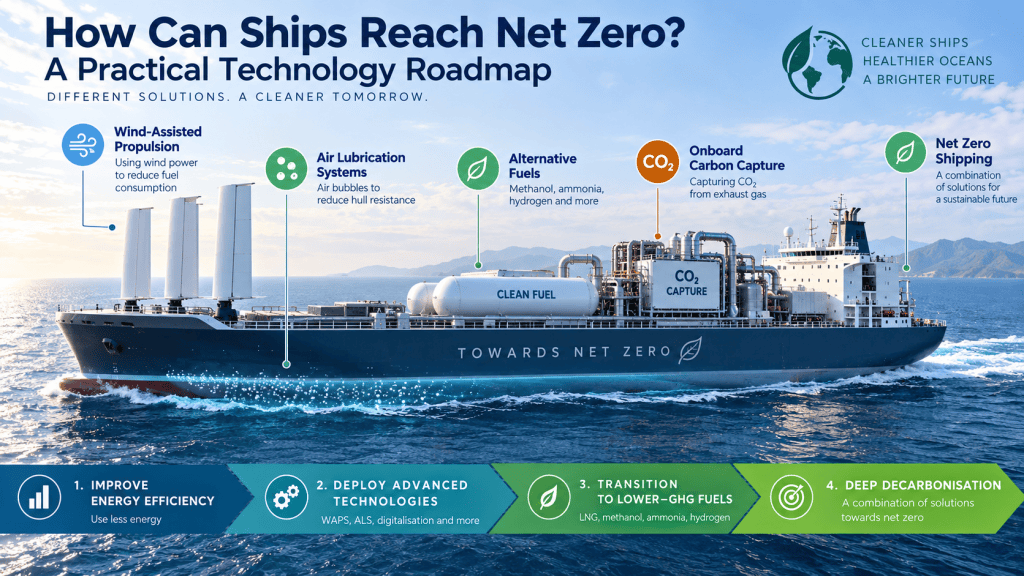
Wind-assisted propulsion can reduce propulsion power. Air lubrication can reduce hull resistance. Digital optimisation can improve vessel operation. Alternative fuels can significantly change lifecycle emissions. Onboard carbon capture may provide another pathway for certain ships.
The practical route to net zero will therefore require a combination of technologies rather than a single solution.
This article presents a practical technology roadmap for how ships could progress from today’s efficiency improvements towards long-term net-zero operation.
1. The Starting Point: Improve Energy Efficiency
Before changing fuels or installing complex new systems, one fundamental principle should come first:
Use less energy.
Every unit of energy that a ship does not need to consume reduces fuel consumption, operating cost and emissions.
Energy-efficiency measures may include:
- Hull optimisation
- Propeller improvements
- Energy-saving devices
- Waste heat recovery
- Variable-speed pumps and fans
- Efficient auxiliary machinery
- Improved hull coatings
- Voyage optimisation
- Weather routing
- Just-in-time arrival
For existing ships, many of these technologies can be introduced through retrofit projects without fundamentally changing the propulsion system.
Energy efficiency therefore provides the foundation for almost every maritime decarbonisation pathway.
2. Reduce Propulsion Demand with Wind
Wind-Assisted Propulsion Systems (WAPS) are bringing wind power back to commercial shipping in a modern form.
Current technologies include:
- Rotor sails
- Suction sails
- Wing sails
- Other automated wind propulsion systems
Instead of completely replacing the main engine, these systems generate additional aerodynamic thrust.
When wind conditions are favourable, the main engine can therefore operate at lower power while maintaining the required vessel speed.
The actual savings depend heavily on the vessel, route, wind conditions, operating speed and system configuration.
This means WAPS should not simply be evaluated according to its maximum theoretical saving.
The more important question is:
How much verified annual fuel and energy saving can the system deliver across the vessel’s real operating profile?
For suitable vessels and routes, wind propulsion could become an important part of the net-zero technology mix.
3. Reduce Hull Resistance with Air Lubrication
A ship also consumes significant energy overcoming resistance between its hull and the surrounding water.
Air Lubrication Systems (ALS) attempt to reduce part of this resistance by supplying air beneath the hull.
A layer or distribution of air bubbles between the hull surface and seawater can reduce frictional resistance.
The potential advantage of ALS is that it does not depend on wind availability.
However, the system requires energy to generate and distribute air.
Therefore, as with other efficiency technologies, the important measure is not gross resistance reduction but:
Net energy saving after accounting for the power consumed by the system itself.
WAPS and ALS work on fundamentally different physical principles, which means they may potentially be used together.
One reduces propulsion demand through wind-generated thrust.
The other reduces the resistance that propulsion must overcome.
4. Digitalisation Can Reduce Wasted Energy
Not every decarbonisation technology needs to involve major physical equipment.
Digital technologies can also improve vessel efficiency.
Examples include:
- Weather routing
- Voyage optimisation
- Speed optimisation
- Trim optimisation
- Machinery performance monitoring
- Hull and propeller condition monitoring
- Predictive maintenance
- AI-supported operational decision-making
One particularly important concept is just-in-time arrival.
Ships sometimes sail faster than necessary only to arrive at a port and wait for a berth.
If port schedules and vessel operations can be better coordinated, ships may be able to reduce speed during the voyage and arrive closer to the actual berthing time.
This can reduce unnecessary fuel consumption without changing the vessel’s propulsion technology.
IMO itself identifies operational optimisation, including just-in-time operations, as an important part of shipping’s emissions-reduction pathway.
5. Existing Ships Need a Different Roadmap
A major challenge for maritime decarbonisation is that thousands of vessels already operating today may remain in service for many years.
Replacing the entire global fleet is neither practical nor economically realistic in the short term.
Existing ships may therefore follow a pathway such as:
Operational optimisation → Energy-efficiency retrofit → WAPS / ALS → Lower-GHG fuel → Carbon capture where appropriate
The exact sequence will differ from vessel to vessel.
For example, an older ship with limited remaining operational life may justify relatively simple efficiency improvements but not a major propulsion conversion.
A younger vessel may justify a more substantial retrofit if it is expected to remain in service through increasingly stringent emissions requirements.
The remaining lifetime of the vessel therefore becomes an important investment consideration.
6. Alternative Fuels Will Be Essential
Efficiency technologies can significantly reduce energy demand, but they cannot eliminate all emissions from a ship continuing to burn conventional fossil fuels.
Eventually, the energy source itself must change.
Potential marine fuels include:
LNG
LNG can reduce certain air pollutants and CO₂ emissions at combustion compared with conventional oil fuels.
However, methane slip and upstream emissions are important considerations.
Its long-term climate performance therefore depends on lifecycle emissions and the potential transition towards bio-LNG or synthetic methane.
Methanol
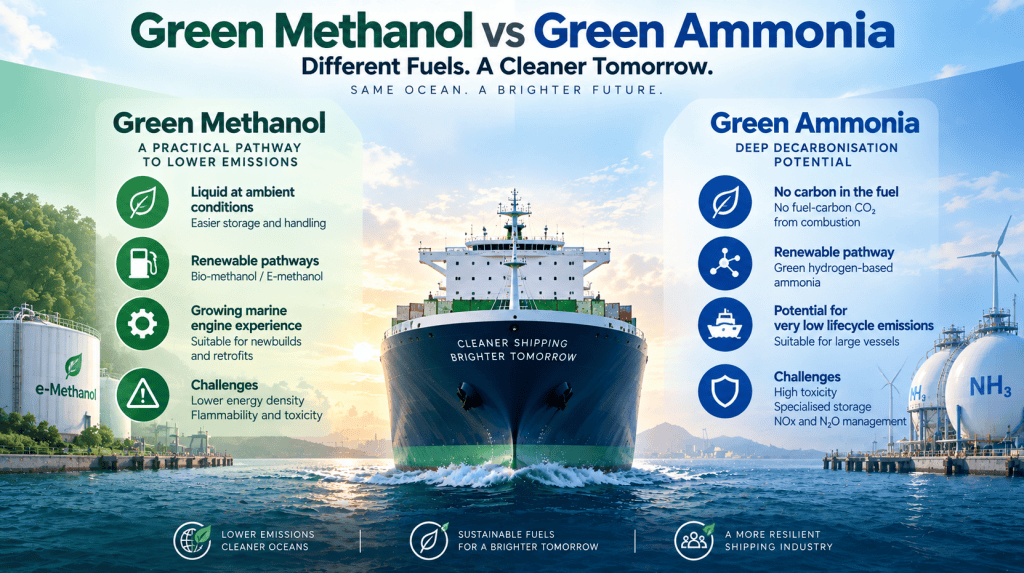
Methanol is attracting significant interest because it is liquid under normal ambient conditions and can be easier to handle than some other alternative fuels.
However, fossil methanol still produces significant lifecycle GHG emissions.
Bio-methanol and renewable e-methanol offer greater long-term decarbonisation potential.
Ammonia
Ammonia contains no carbon and therefore does not produce CO₂ from the fuel itself during combustion.
However, toxicity, NOx, N₂O, ammonia slip, production pathway and infrastructure remain important considerations.
Green ammonia produced using renewable energy could potentially play an important role in deep-sea shipping.
Hydrogen
Hydrogen also contains no carbon.
It may be used in fuel cells or combustion engines, but storage volume, cryogenic requirements for liquid hydrogen, safety and infrastructure create significant challenges.
Green hydrogen could nevertheless become important in selected maritime applications and as a feedstock for producing other synthetic fuels.
7. The Fuel Name Alone Does Not Determine Sustainability
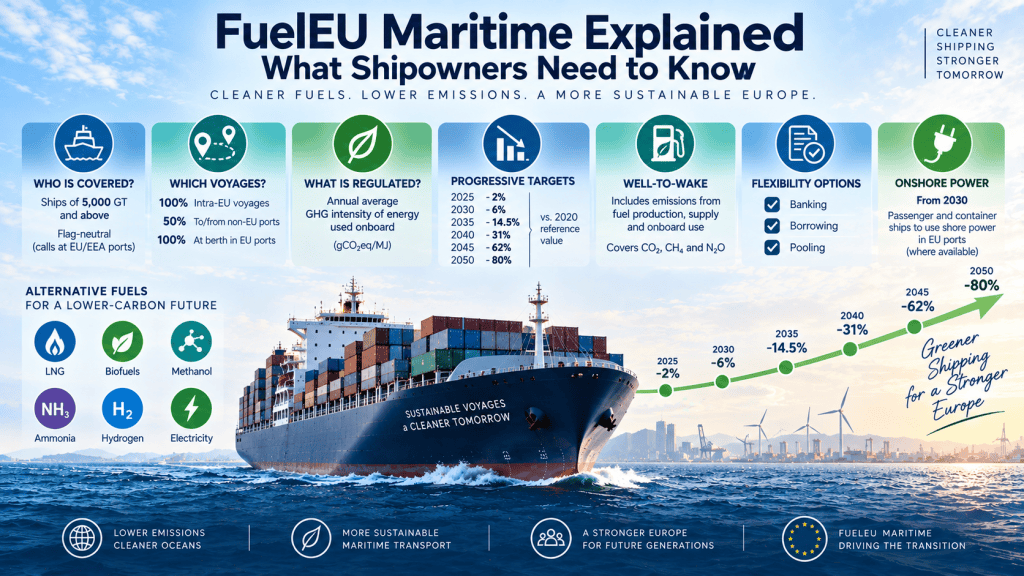
A critical change in maritime decarbonisation is the move towards Well-to-Wake assessment.
It is no longer sufficient to consider only what comes from the ship’s funnel.
The complete fuel lifecycle matters:
Raw material → Fuel production → Transportation → Bunkering → Onboard use
IMO’s lifecycle framework divides this broadly into:
Well-to-Tank + Tank-to-Wake = Well-to-Wake
This is particularly important for hydrogen-based fuels.
For example, hydrogen produced from fossil fuels without sufficient carbon mitigation can have a very different lifecycle GHG footprint from hydrogen produced using renewable electricity.
Similarly, methanol and ammonia can have dramatically different emissions depending on how they are produced.
IMO’s 2023 GHG Strategy explicitly incorporates Well-to-Wake emissions into the pathway towards net-zero shipping.
8. Onboard Carbon Capture Could Provide Another Pathway
Another developing option is Onboard Carbon Capture and Storage (OCCS).
Instead of eliminating carbon from the fuel, OCCS attempts to capture part of the CO₂ produced by combustion before it reaches the atmosphere.
The captured CO₂ can then be processed, stored onboard and later discharged to suitable shore infrastructure.
This may be particularly relevant for:
- Existing vessels
- Ships with significant remaining operational life
- Large vessels with sufficient onboard space
- Ships operating routes with access to CO₂ reception infrastructure
However, carbon capture introduces additional equipment, weight, energy consumption and storage requirements.
The complete carbon chain must also exist ashore.
Capturing CO₂ onboard is therefore only useful if the captured carbon can ultimately be transported, utilised appropriately or permanently stored.
9. Combining Technologies May Be More Powerful
The future may not be:
WAPS or ALS or alternative fuels.
It may instead be:
WAPS + ALS + Digital Optimisation + Efficient Machinery + Lower-GHG Fuel
and, for some vessels:
+ Onboard Carbon Capture
Consider a hypothetical ship that first reduces its energy requirement through efficiency improvements.
If WAPS provides additional propulsion assistance and ALS further reduces hull resistance, the vessel requires less fuel.
If the remaining fuel is then replaced by a lower-GHG energy source, lifecycle emissions can fall further.
The important principle is:
Reduce energy demand first, then decarbonise the remaining energy supply.
10. A Practical Net-Zero Technology Roadmap
A practical roadmap can be divided into four stages.
Stage 1 — Immediate Efficiency
Focus on technologies available today:
- Hull and propeller optimisation
- Energy-saving devices
- Machinery efficiency
- Weather routing
- Voyage optimisation
- Speed optimisation
- Just-in-time arrival
- Improved maintenance
Objective:
Reduce unnecessary fuel consumption immediately.
Stage 2 — Advanced Energy-Saving Technologies
Introduce technologies suitable for the vessel:
- Wind-Assisted Propulsion
- Air Lubrication Systems
- Waste heat recovery
- Advanced propulsion optimisation
- Digital energy-management systems
Objective:
Further reduce the vessel’s total energy demand.
Stage 3 — Transition to Lower-GHG Fuels
Depending on vessel type and fuel availability:
- Biofuels
- Bio-LNG
- Methanol
- E-methanol
- Ammonia
- Hydrogen
- Synthetic fuels
Objective:
Reduce the lifecycle GHG intensity of the remaining energy requirement.
Stage 4 — Deep Decarbonisation
Combine:
Maximum practical efficiency + zero or near-zero GHG fuels + renewable energy + carbon management where appropriate
Objective:
Move towards net-zero lifecycle GHG emissions.
11. CII Will Continue to Influence Existing Ships
The Carbon Intensity Indicator (CII) provides an operational measure of how efficiently a ship transports cargo or passengers relative to its CO₂ emissions.
As carbon-intensity requirements become progressively more demanding, shipowners have an incentive to improve operational performance.
This can encourage measures such as:
- Speed optimisation
- Hull cleaning
- Propeller improvement
- Energy-saving devices
- WAPS
- ALS
- Operational optimisation
- Lower-carbon fuels
CII should therefore be viewed not simply as a compliance exercise but as one factor influencing the broader efficiency strategy of the existing fleet.
IMO is continuing its Phase 2 review of the short-term measures, including CII and SEEMP, through 2028.
12. The IMO Net-Zero Direction
The IMO’s 2023 GHG Strategy sets an overall ambition for international shipping to reach net-zero GHG emissions by or around 2050.
It also establishes indicative checkpoints compared with 2008:
- By 2030: at least 20% reduction, striving for 30%
- By 2040: at least 70% reduction, striving for 80%
The Strategy also calls for zero or near-zero GHG emission technologies, fuels and/or energy sources to represent at least 5%, striving for 10%, of the energy used by international shipping by 2030.
IMO is also developing its Net-Zero Framework around two main elements:
A marine fuel standard + a GHG pricing mechanism
However, as of September 2026, the Framework should not be described as a fully adopted and effective regulation.
Following MEPC 84 in April–May 2026, IMO scheduled further intersessional negotiations ahead of MEPC 85 later in 2026, with the extraordinary MEPC session expected to resume in December.
For the maritime industry, however, the direction is increasingly clear:
Future competitiveness will depend on both energy efficiency and lifecycle GHG performance.
13. Shipowners Need Vessel-Specific Strategies
There is no universal net-zero roadmap suitable for every ship.
A VLCC, container vessel, LNG carrier, bulk carrier, ferry and coastal vessel operate under very different conditions.
Important factors include:
- Vessel type
- Vessel age
- Remaining operational life
- Trading route
- Operating speed
- Weather conditions
- Available deck space
- Fuel availability
- Port infrastructure
- Retrofit cost
- Cargo impact
- Regulatory exposure
Technology selection should therefore begin with the vessel’s actual operating profile.
The right question is not:
“Which green technology is best?”
It is:
“Which combination of technologies delivers the greatest verified lifecycle GHG reduction for this particular vessel?”
15. Net Zero Is a System Challenge
Perhaps the most important lesson is that maritime decarbonisation extends beyond the ship itself.
A zero- or near-zero-GHG vessel also depends on:
- Renewable electricity
- Fuel production
- Fuel transportation
- Bunkering infrastructure
- Ports
- Shipyards
- Equipment manufacturers
- Classification societies
- Regulators
- Financial institutions
- Carbon storage infrastructure
Shipping therefore cannot reach net zero through vessel technology alone.
The entire maritime energy ecosystem must evolve.
Conclusion
There is unlikely to be a single technology that takes international shipping from today’s fossil-fuel fleet directly to net zero.
The more practical pathway is likely to be a combination of measures.
First:
Reduce the amount of energy the ship needs.
Then:
Use energy-saving technologies to reduce demand further.
Next:
Reduce the lifecycle GHG intensity of the remaining fuel.
And where technically and economically appropriate:
Use additional technologies such as onboard carbon capture to address remaining emissions.
The future net-zero vessel may therefore not be defined by one revolutionary technology.
Instead, it may be a highly integrated ship combining:
Efficient hull + Optimised propulsion + WAPS + ALS + Digital optimisation + Zero/near-zero GHG fuel + Carbon management
Ultimately, the most successful decarbonisation strategy will not be the one with the largest number of green technologies.
It will be the one that delivers the greatest verified lifecycle GHG reduction while remaining technically reliable, operationally practical and economically sustainable.


답글 남기기