Introduction
Improving the efficiency of existing ships is becoming increasingly important as the maritime industry works towards lower greenhouse gas emissions.
New vessels can be designed around alternative fuels and advanced propulsion systems from the beginning. However, a large proportion of the global fleet operating today will remain in service for many years.
Replacing every vessel with a new low-emission ship is neither economically nor practically realistic.
For many shipowners, the more immediate question is therefore:
How can an existing ship reduce fuel consumption and emissions without being completely replaced?
A growing range of energy-saving technologies can help. Some involve relatively simple operational improvements, while others require significant retrofit investment.
The most effective solution will depend on vessel type, operating profile, remaining service life and commercial requirements.
1. Why Existing Ships Need to Become More Efficient
Fuel efficiency has always been important because fuel represents a major operating cost for most commercial vessels.
Today, however, efficiency has an additional strategic importance.
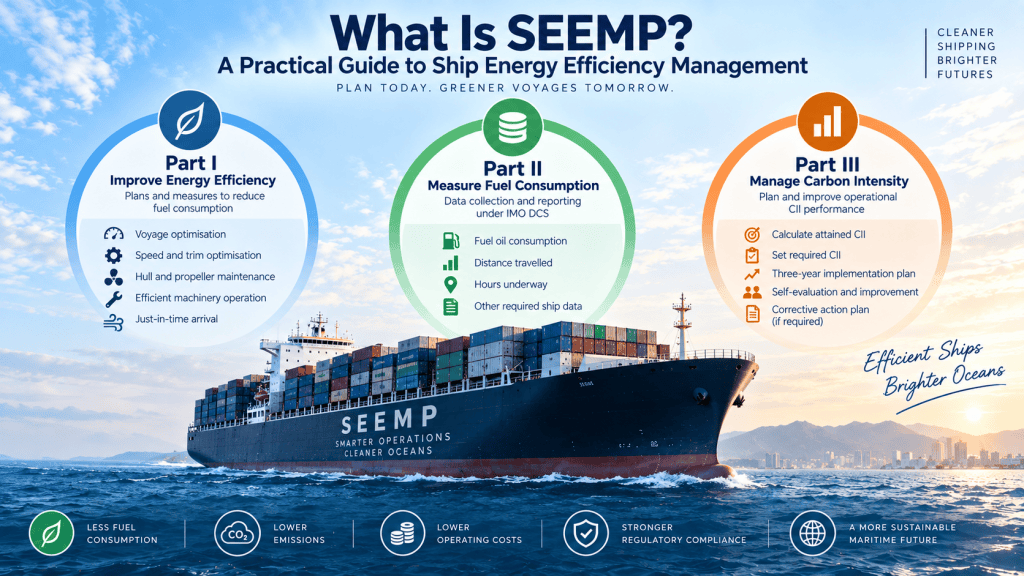
IMO regulations such as the Carbon Intensity Indicator (CII) are placing increasing pressure on vessels to improve operational carbon intensity over time.
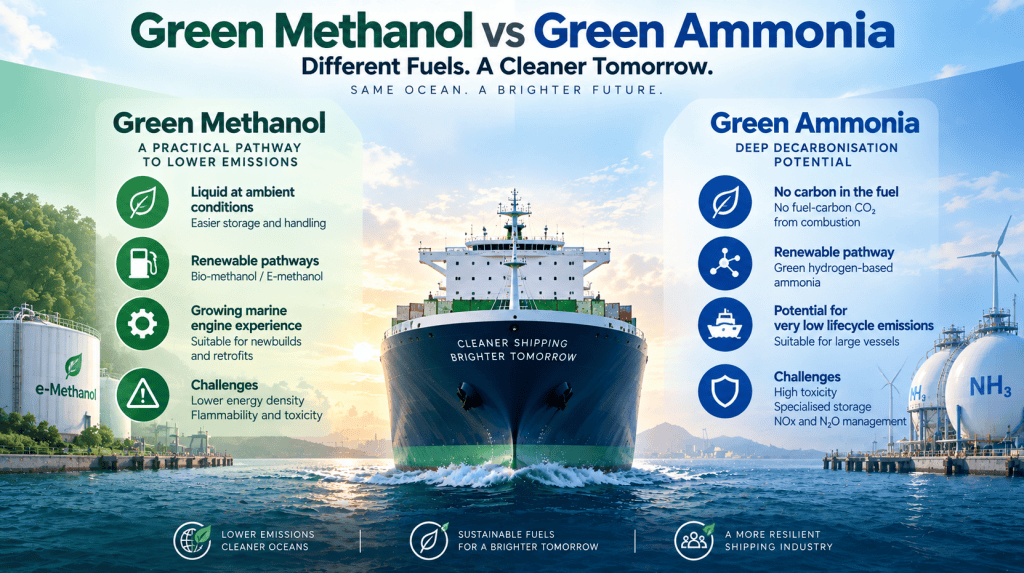
At the same time, future low-GHG fuels such as green methanol, ammonia and renewable hydrogen are expected to be more expensive and potentially less widely available than conventional marine fuels during the transition.
Reducing the amount of energy a ship requires therefore creates two benefits:
lower fuel consumption today and lower future demand for expensive low-GHG fuels.
This is why efficiency improvement is likely to remain important regardless of which fuels eventually dominate the maritime energy transition.
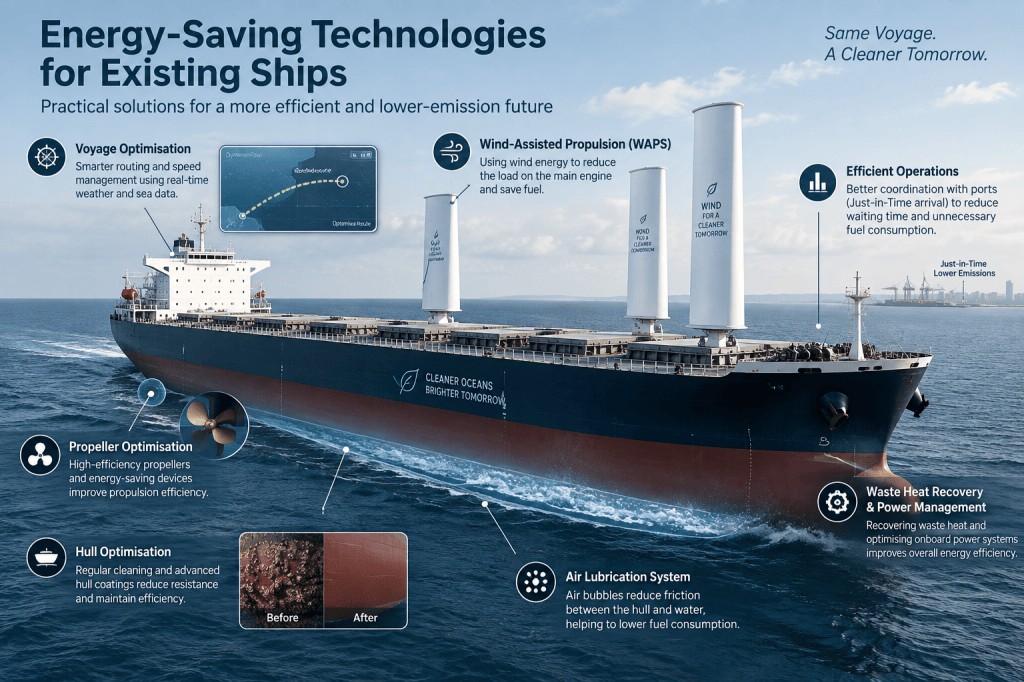
2. Hull and Propeller Optimisation
One of the most fundamental ways to reduce fuel consumption is to minimise resistance through the water.
Over time, marine growth and surface deterioration can increase hull resistance. Even relatively small increases in resistance can lead to additional propulsion power requirements.
Regular hull cleaning and effective antifouling coatings can therefore contribute to maintaining vessel efficiency.
Propeller condition is equally important.
Propeller polishing, improved blade designs and retrofit devices around the propeller or rudder can potentially improve propulsion efficiency.
Depending on the vessel, retrofit solutions may include:
- propeller boss cap fins
- pre-swirl devices
- ducts
- rudder bulbs
- high-efficiency propellers
These technologies aim to recover energy or improve water flow around the propeller and rudder.
3. Wind-Assisted Propulsion
Wind-assisted propulsion systems, or WAPS, use wind energy to supplement the vessel’s main propulsion system.
Modern systems include:
- rotor sails
- suction sails
- wing sails
- towing kites
Unlike traditional sailing ships, these technologies are generally designed to work together with the vessel’s conventional propulsion system.
When wind conditions are favourable, the additional thrust generated by the wind system can reduce the power required from the main engine.
The actual fuel saving depends on several factors, including vessel route, wind conditions, ship speed, available deck space and the type and number of wind devices installed.
WAPS can be particularly interesting for vessels operating on routes with favourable and predictable wind conditions.
Internal Link
Link the words “Wind-assisted propulsion systems” to your existing article:
Wind-Assisted Propulsion: How Wind Is Returning to Modern Shipping
4. Air Lubrication Systems
Air lubrication is another technology attracting interest for both newbuilds and retrofits.
An air lubrication system introduces air beneath the vessel’s hull to reduce friction between the hull surface and the surrounding water.
Depending on the system design, vessel characteristics and operating conditions, this can reduce the propulsion power required to maintain a given speed.
The technology can be particularly attractive for larger vessels with suitable flat-bottom hull areas.
However, the overall benefit must take into account the energy required to generate and distribute the air.
The net energy saving therefore depends on the balance between reduced hull resistance and the power consumed by the air supply system.
Internal Link
Link “Air Lubrication System” to:
Air Lubrication Systems: How Air Bubbles Can Improve Ship Efficiency
5. Waste Heat Recovery
Large marine engines generate significant amounts of heat that would otherwise be discharged through exhaust gases and cooling systems.
Waste heat recovery systems attempt to capture some of this energy and use it productively.
Depending on the vessel and system design, recovered heat can be used for steam generation, electricity production or other onboard energy requirements.
By reducing the amount of additional fuel required to generate electricity or heat, waste heat recovery can improve overall vessel efficiency.
However, retrofit feasibility depends on machinery arrangement, available space, engine load profile and the remaining operational life of the vessel.
6. Shaft Generators and Power Management
Modern power-management strategies can also improve vessel efficiency.
A shaft generator uses power from the main propulsion shaft to generate electricity for onboard systems.
Under suitable operating conditions, this can be more efficient than operating separate auxiliary diesel generators.
Variable-frequency technologies and advanced power-management systems can further optimise the balance between propulsion and electrical loads.
Battery systems may also be integrated in certain applications to manage peak loads, support auxiliary power requirements or enable hybrid operation.
The optimal configuration depends strongly on the vessel’s operating profile.
7. Voyage and Weather Optimisation
Not every energy-saving measure requires major hardware installation.
Digital voyage optimisation can reduce fuel consumption by helping vessels select more efficient routes and operating speeds.
Modern systems can consider:
- weather conditions
- waves and currents
- vessel performance
- arrival schedules
- fuel consumption
- engine operating conditions
For example, maintaining high speed only to arrive at a congested port and wait at anchor can result in unnecessary fuel consumption.
Better coordination between ships, charterers and ports can enable Just-in-Time arrival, allowing vessels to optimise speed and reduce waiting time.
Digitalisation can therefore become an important energy-efficiency tool.
8. Speed Optimisation
Vessel speed has a major influence on propulsion power demand.
For many displacement vessels, the power required increases rapidly as speed increases.
Reducing speed can therefore produce significant fuel savings.
However, speed optimisation is not simply a matter of operating as slowly as possible.
Commercial schedules, weather, charter-party requirements, cargo commitments and port availability must all be considered.
The objective is to identify the most efficient speed for the overall voyage rather than focusing only on maximum vessel speed.
9. Machinery and Engine Optimisation
Main engines and auxiliary machinery can gradually lose efficiency if they are not properly maintained or operated.
Engine tuning, turbocharger maintenance, fuel injection optimisation and monitoring of combustion performance can help maintain efficient operation.
Pumps, fans and other auxiliary equipment can also consume substantial amounts of electricity.
Variable-frequency drives can allow some equipment to operate according to actual demand rather than continuously at full capacity.
Individually, these improvements may appear relatively small, but combined savings across multiple onboard systems can become meaningful.
10. Hull Coatings
Advanced hull coatings can help maintain a smoother underwater surface and reduce biological fouling.
The effectiveness of a coating depends on factors including:
- vessel speed
- trading pattern
- water temperature
- idle periods
- maintenance practices
A vessel spending long periods at anchor may experience different fouling conditions from a ship operating continuously at relatively high speed.
Selecting an appropriate coating system should therefore consider the vessel’s actual operating profile rather than relying on a single solution for every ship.
11. Combining Multiple Technologies
One of the most important principles of ship efficiency is that there may be no single technology capable of delivering the entire required improvement.
A vessel might combine:
Hull optimisation + Propeller improvement + WAPS + Air lubrication + Voyage optimisation
Each measure contributes to reducing the total propulsion energy requirement.
However, savings cannot always simply be added together.
Technologies can interact with one another, and improving one part of the vessel may change the potential benefit of another technology.
A proper vessel-specific analysis is therefore important before making investment decisions.
12. How Should Shipowners Evaluate Retrofit Technologies?
Fuel-saving percentage alone should not determine whether a retrofit is commercially attractive.
Shipowners should consider several factors:
- capital cost
- expected fuel saving
- fuel price
- installation time
- dry-docking requirements
- maintenance cost
- reliability
- remaining vessel life
- impact on cargo operations
- regulatory benefits
- future fuel strategy
A technology offering a large theoretical saving may not be attractive if installation is extremely expensive or operational disruption is significant.
Conversely, a relatively simple technology with a smaller saving may provide a short payback period.
The correct comparison should therefore be based on lifecycle economics, not simply headline fuel-saving percentages.
13. Energy Efficiency and CII
Energy-saving technologies can also contribute to improving a vessel’s CII performance.
If a technology reduces fuel consumption while the vessel performs similar transport work, its operational carbon intensity can improve.
This creates an additional reason for shipowners to consider efficiency retrofits as CII requirements become progressively stricter.
Internal Link
Link “CII performance” to:
CII Explained: How the Carbon Intensity Indicator Affects Ships
14. Efficiency Before Alternative Fuels
Alternative fuels will be essential for achieving deep maritime decarbonisation, but changing fuel alone does not eliminate the importance of vessel efficiency.
Imagine two ships operating on expensive green methanol.
If one vessel requires 20% less energy to perform the same transport work, it will require substantially less green fuel.
The same principle applies to ammonia, hydrogen, biofuels and other future fuels.
Energy efficiency therefore reduces both emissions and the quantity of alternative fuel that needs to be produced, transported and stored.
This makes efficiency one of the most fuel-neutral strategies available to the maritime industry.
15. The Future of Existing Ships
The transition to low-GHG shipping will not happen overnight.
Thousands of vessels currently in operation will continue sailing through the 2030s and, in some cases, beyond.
Many of these vessels will need to improve their environmental performance during their remaining service lives.
For some ships, operational optimisation may be sufficient.
Others may require substantial retrofits involving propulsion systems, energy-saving devices or alternative-fuel capability.
In some cases, replacement may ultimately become more economical than continued investment.
The correct pathway will therefore vary from vessel to vessel.
Conclusion
Improving the efficiency of existing ships is one of the most practical ways to reduce maritime fuel consumption and emissions in the near and medium term.
A wide range of options is available, from hull cleaning, propeller optimisation and digital voyage planning to more significant technologies such as wind-assisted propulsion, air lubrication and waste heat recovery.
No single technology will be suitable for every vessel.
The most effective strategy is likely to combine operational improvements with carefully selected technical solutions based on vessel type, trading pattern and remaining service life.
Most importantly, energy efficiency remains valuable regardless of which future fuel ultimately powers the vessel.
As low-GHG fuels become increasingly important, the cleanest unit of energy may often be the one that the ship does not need to consume.



답글 남기기