Introduction
Improving the energy efficiency of ships has become a central part of maritime decarbonisation.
However, the growing number of IMO efficiency regulations can sometimes be confusing.
Three terms appear particularly frequently:
EEDI, EEXI and CII.
Although they are related, they measure different aspects of ship efficiency.
In simple terms:
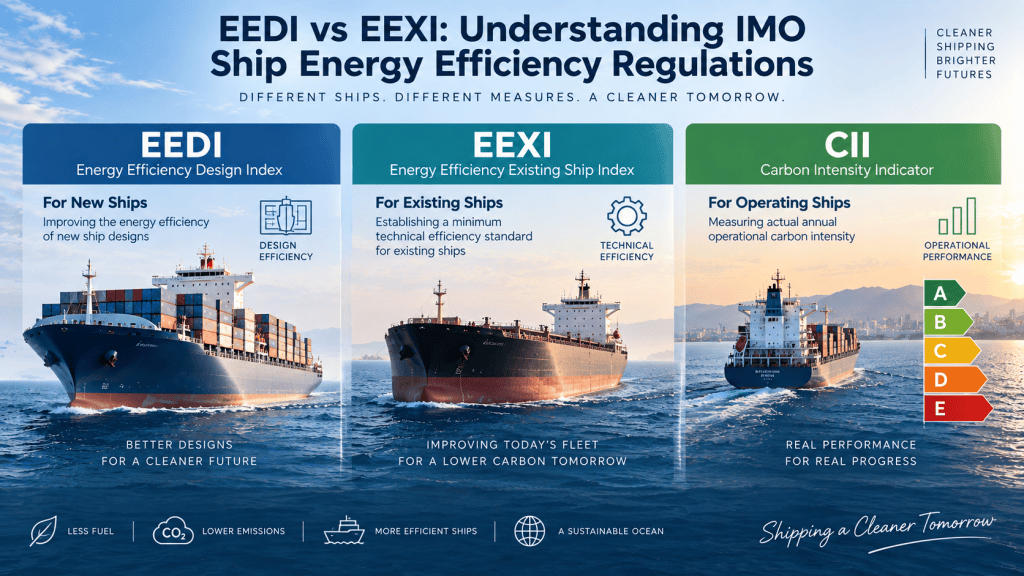
EEDI focuses mainly on the design efficiency of new ships.
EEXI applies a similar technical efficiency concept to existing ships.
CII measures how efficiently a ship actually operates each year.
Understanding these differences is important for shipowners, shipyards, designers and equipment suppliers as the maritime industry moves towards increasingly stringent energy-efficiency and greenhouse gas requirements.
1. What Is EEDI?
EEDI stands for:
Energy Efficiency Design Index
It was introduced by the International Maritime Organization as part of mandatory energy-efficiency requirements under MARPOL Annex VI.
The fundamental objective of EEDI is relatively simple:
Encourage new ships to be designed with better energy efficiency.
Rather than specifying exactly which technology a shipbuilder must use, the regulation establishes an efficiency requirement that the ship must achieve.
This technology-neutral approach allows designers and shipyards to determine the most appropriate combination of technologies.
These may include:
- More efficient hull forms
- Improved propulsion systems
- More efficient engines
- Propeller optimisation
- Waste heat recovery
- Energy-saving devices
- Renewable energy assistance
- Other efficiency technologies
The result is an efficiency value representing the ship’s theoretical CO₂ emissions relative to its transport capacity.
2. How Does EEDI Work?
At a simplified conceptual level, EEDI considers:
CO₂ emissions from propulsion and auxiliary power
relative to:
Ship capacity × Reference speed
The index is commonly expressed in terms of CO₂ emissions per unit of transport work.
A lower EEDI generally represents a more energy-efficient ship design.
The ship’s calculated value is known as the:
Attained EEDI
This is compared with the:
Required EEDI
The ship must meet the applicable required efficiency level.
Importantly, EEDI is fundamentally a design index.
It evaluates the technical efficiency characteristics of the vessel rather than measuring its actual annual fuel consumption during commercial operation.
3. Why Was EEXI Introduced?
EEDI primarily addressed new ships.
However, international shipping includes a very large fleet of existing vessels that may continue operating for many years.
IMO therefore needed a mechanism to establish technical energy-efficiency requirements for existing ships as well.
This led to:
EEXI — Energy Efficiency Existing Ship Index
The concept is closely related to EEDI, but it extends technical efficiency requirements to the existing fleet.
IMO describes EEXI as reflecting the technical or design efficiency of an existing ship. Existing ships generally need to achieve a required EEXI linked to the EEDI reference framework.
4. What Is EEXI?
EEXI stands for:
Energy Efficiency Existing Ship Index
The attained EEXI represents the technical energy efficiency of an existing vessel compared with a reference baseline.
The basic compliance principle is:
Attained EEXI ≤ Required EEXI
In other words, the ship’s calculated attained value must be at or below the applicable required value.
A lower index indicates better technical energy efficiency.
EEXI generally applies to ships of 400 gross tonnage and above, subject to the detailed applicability provisions of MARPOL Annex VI and the relevant ship categories.
The EEXI requirements became effective from 1 January 2023.
5. EEDI vs EEXI: What Is the Difference?
The easiest way to understand the difference is:
| EEDI | EEXI | |
|---|---|---|
| Full name | Energy Efficiency Design Index | Energy Efficiency Existing Ship Index |
| Main focus | New ship design efficiency | Existing ship technical efficiency |
| Nature | Technical/design measure | Technical/design measure |
| Main objective | Improve efficiency of new ships | Establish minimum efficiency for existing ships |
| Based on | Ship design characteristics | Existing ship characteristics |
| Operational performance | Not directly measured | Not directly measured |
Therefore:
EEDI asks: How efficiently is the new ship designed?
EEXI asks: Does the existing ship meet the required technical efficiency standard?
Neither should be confused with actual annual operational performance.
That is where CII becomes important.
6. How Can Ships Improve EEXI?
If a ship’s attained EEXI does not meet the required level, several technical solutions may be considered.
One of the most widely discussed approaches is:
Engine Power Limitation
Engine Power Limitation (EPL) restricts the maximum available propulsion power during normal operation.
Reducing the relevant engine power used in the EEXI calculation can help improve the ship’s attained EEXI.
Shaft Power Limitation
A similar concept can be applied through:
Shaft Power Limitation (ShaPoLi)
Instead of limiting engine output directly, the system limits the power transmitted through the propulsion shaft.
IMO has specific guidelines covering shaft/engine power limitation systems and the use of a power reserve for EEXI compliance.
7. Is Power Limitation the Only Solution?
No.
EEXI is technology-neutral.
IMO does not require every ship to use EPL or ShaPoLi.
Other technical improvements may contribute to better energy efficiency, depending on the vessel.
Examples include:
- Propeller optimisation
- Energy-saving devices
- Waste heat recovery
- Hull efficiency improvements
- Wind-assisted propulsion
- Machinery improvements
IMO specifically identifies engine/shaft power limitation, waste heat recovery and wind-assisted propulsion among technologies that can support compliance with Required EEXI.
This technology-neutral approach is important because ships have very different designs and operating requirements.
8. Can Wind-Assisted Propulsion Improve EEXI?
Wind-Assisted Propulsion Systems can potentially contribute to ship energy efficiency.
Examples include:
- Rotor sails
- Suction sails
- Wing sails
These technologies generate additional propulsion force from wind energy, potentially reducing the propulsion power required from the main engine.
However, incorporating wind propulsion into regulatory efficiency calculations requires appropriate methodologies.
This remains an area of regulatory development. In 2026, IMO’s Phase 2 review of the short-term GHG measures includes consideration of EEDI and EEXI calculations for wind propulsion.
This could become increasingly important as WAPS installations expand across commercial shipping.
9. EEXI vs CII: The Critical Difference
EEXI and CII are sometimes discussed together because both became mandatory under IMO’s short-term GHG reduction measures.
However, they are fundamentally different.
EEXI = Technical Efficiency
EEXI considers the technical characteristics of the ship.
It does not directly measure how efficiently the vessel was actually operated throughout the year.
CII = Operational Efficiency
CII stands for:
It measures a ship’s annual operational carbon intensity.
CII therefore reflects factors such as:
- Actual fuel consumption
- Distance travelled
- Ship capacity
- Operational profile
Ships subject to CII receive an annual rating:
A / B / C / D / E
where A represents the best performance level.
IMO requires CII for relevant ships of 5,000 GT and above.
10. A Simple Example
Imagine two identical ships.
Both have exactly the same:
- Hull
- Engine
- Propeller
- Installed equipment
- EEXI
From a technical perspective, they are essentially identical.
However, Ship A is operated efficiently.
It uses:
- Optimised speed
- Good weather routing
- Regular hull cleaning
- Efficient voyage planning
Ship B operates less efficiently.
It experiences:
- Higher unnecessary speeds
- Poor hull condition
- Less efficient routing
- More fuel consumption
The ships may have similar EEXI values because their technical designs are similar.
But their annual CII performance could be very different.
This illustrates the fundamental distinction:
EEXI evaluates the ship.
CII also reflects how the ship is operated.
11. Why EEXI Compliance Does Not Guarantee a Good CII Rating
A ship can comply with EEXI and still receive a poor CII rating.
This is because satisfying a technical efficiency requirement does not guarantee efficient operation.
For example, a vessel may technically comply with EEXI through EPL.
However, if the ship:
- Consumes excessive fuel
- Operates inefficiently
- Has a heavily fouled hull
- Uses inefficient voyage planning
its operational carbon intensity may still be poor.
Conversely, operational improvements can help improve CII even when the ship’s underlying technical configuration remains unchanged.
This is why EEXI and CII should be viewed as complementary rather than interchangeable regulations.
12. How Can Ships Improve CII?
A vessel can potentially improve its operational carbon intensity through a wider range of measures.
These may include:
- Speed optimisation
- Weather routing
- Voyage optimisation
- Just-in-time arrival
- Hull cleaning
- Propeller maintenance
- Energy-saving technologies
- Wind-assisted propulsion
- Air lubrication
- Lower-carbon fuels
IMO similarly identifies hull cleaning, speed and route optimisation and renewable auxiliary energy among measures that can help improve ship carbon-intensity performance.
CII therefore encourages shipowners to think not only about ship design but also about how efficiently vessels are operated throughout their working lives.
13. What Happens If a Ship Has a Poor CII Rating?
CII ratings range from:
A — Major superior
B — Minor superior
C — Moderate
D — Minor inferior
E — Inferior
A ship rated D for three consecutive years or E for one year must develop a corrective action plan showing how it will achieve the required rating of C or above.
This creates an ongoing incentive for shipowners to monitor and improve operational efficiency.
Unlike EEXI, therefore, CII is not simply a one-time technical assessment.
It is an ongoing operational performance requirement.
15. Where Does SEEMP Fit In?
Another important part of the regulatory framework is:
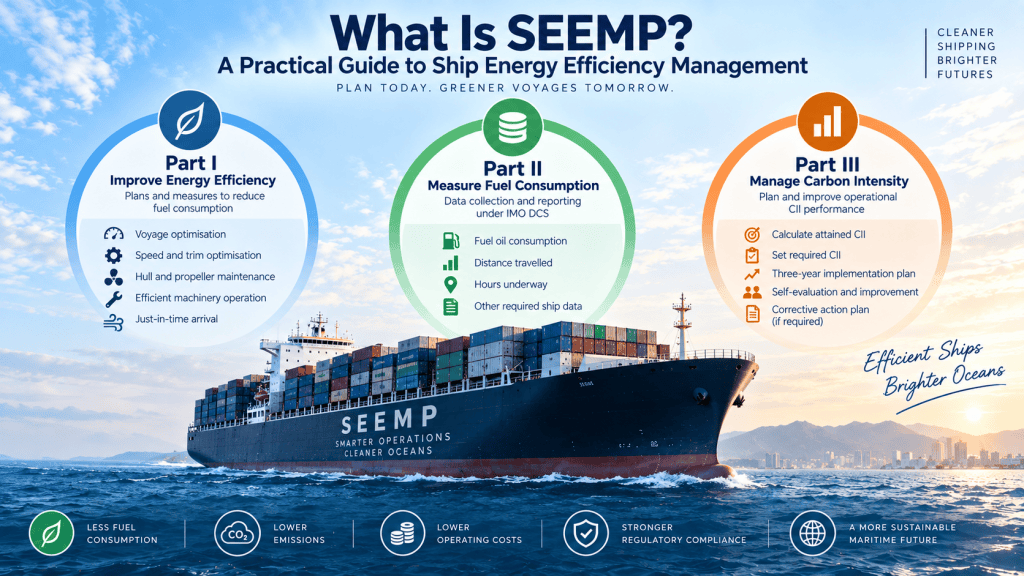
SEEMP — Ship Energy Efficiency Management Plan
SEEMP provides a structured framework for managing and improving ship energy efficiency.
It is closely connected with operational carbon-intensity management and CII.
A shipowner may therefore need to consider several related elements together:
Technical efficiency → EEXI
Operational performance → CII
Energy management → SEEMP
This demonstrates how IMO’s approach combines ship technology with ongoing operational management.
16. What Does This Mean for Shipowners?
For shipowners, compliance should not be viewed only as a calculation exercise.
EEXI and CII can influence broader decisions about:
- Vessel speed
- Retrofit investment
- Energy-saving technologies
- Propulsion upgrades
- Alternative fuels
- Vessel lifetime
- Fleet renewal
An older vessel requiring significant investment may eventually become less economically attractive.
A newer vessel with many years of remaining life may justify more substantial efficiency upgrades.
The correct strategy therefore depends on both:
Technical feasibility + Commercial viability
17. The Regulations Are Still Evolving
EEXI and CII should not be considered the final stage of IMO’s energy-efficiency regulation.
IMO completed Phase 1 of its review of the short-term GHG reduction measures in 2025.
Phase 2 is running from 2026 to 2028 and includes further development of the SEEMP framework and CII metrics. IMO’s 2026 work also includes consideration of EEDI and EEXI calculations for wind propulsion.
This means shipowners and technology suppliers should continue monitoring regulatory developments rather than assuming that today’s requirements will remain unchanged indefinitely.
Conclusion
EEDI, EEXI and CII are closely related, but they serve different purposes.
EEDI established energy-efficiency design requirements primarily for new ships.
EEXI extended a similar technical efficiency approach to the existing fleet.
CII introduced an annual measure of operational carbon-intensity performance.
Together, they represent an important shift in maritime regulation.
Ship efficiency is no longer only a question of how a vessel is designed.
It is also about:
How the ship is equipped, how much energy it requires, and how efficiently it operates throughout its lifetime.
For shipowners, the most effective strategy will therefore be to consider EEXI and CII as part of a broader efficiency programme rather than as isolated compliance requirements.
And as IMO continues reviewing the short-term measures, the direction remains clear:
Better ship design + Better technology + Better operation = Lower energy consumption and lower emissions.



답글 남기기