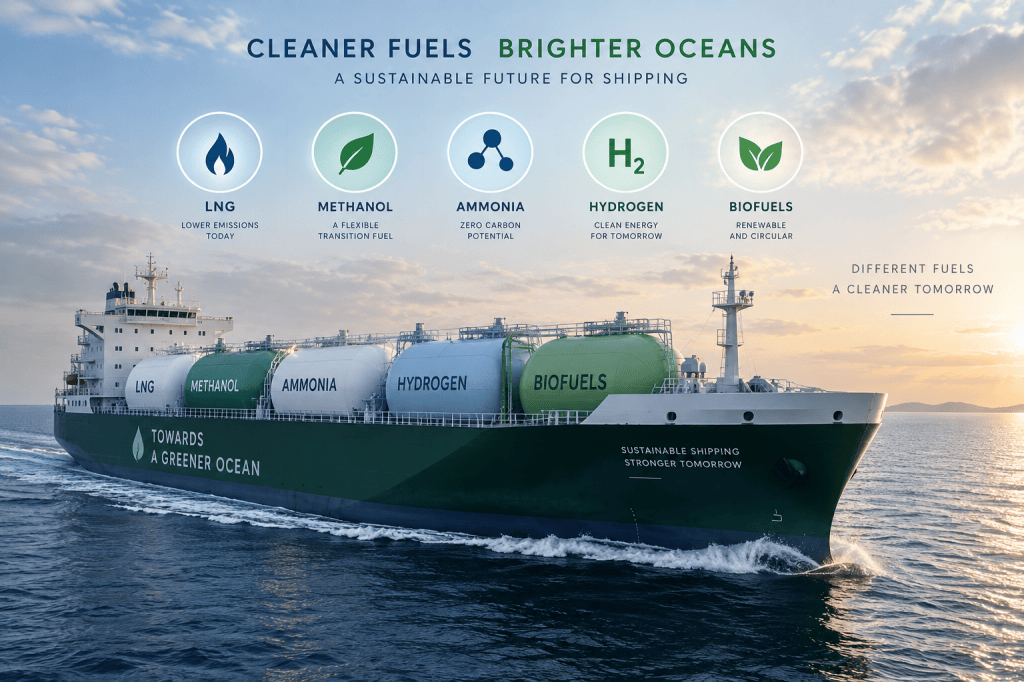
The maritime industry is exploring a wide range of alternative fuels as it works to reduce greenhouse gas emissions and transition away from conventional fossil fuels. LNG, methanol, ammonia, hydrogen and biofuels are among the options receiving increasing attention, but each fuel has different characteristics, advantages and challenges.
There is no single fuel that is likely to meet the needs of every vessel or trade. Fuel availability, energy density, storage requirements, safety, infrastructure, cost and lifecycle greenhouse gas emissions all need to be considered when evaluating the most suitable option for a particular ship and operating profile.
1. Liquefied Natural Gas (LNG)
LNG has been widely adopted as an alternative marine fuel, particularly for newbuild vessels. Compared with conventional oil-based marine fuels, LNG can reduce emissions of sulphur oxides and particulate matter, while also offering the potential to reduce greenhouse gas emissions depending on the engine technology, fuel supply chain and overall lifecycle emissions.
However, LNG remains a fossil fuel when produced from conventional natural gas, and methane slip can reduce its overall greenhouse gas benefit. LNG also requires cryogenic storage and dedicated fuel supply infrastructure. For this reason, its long-term role in maritime decarbonisation will depend partly on how effectively methane emissions are controlled and whether lower-carbon alternatives such as bio-LNG and synthetic LNG become available at scale.
2. Methanol
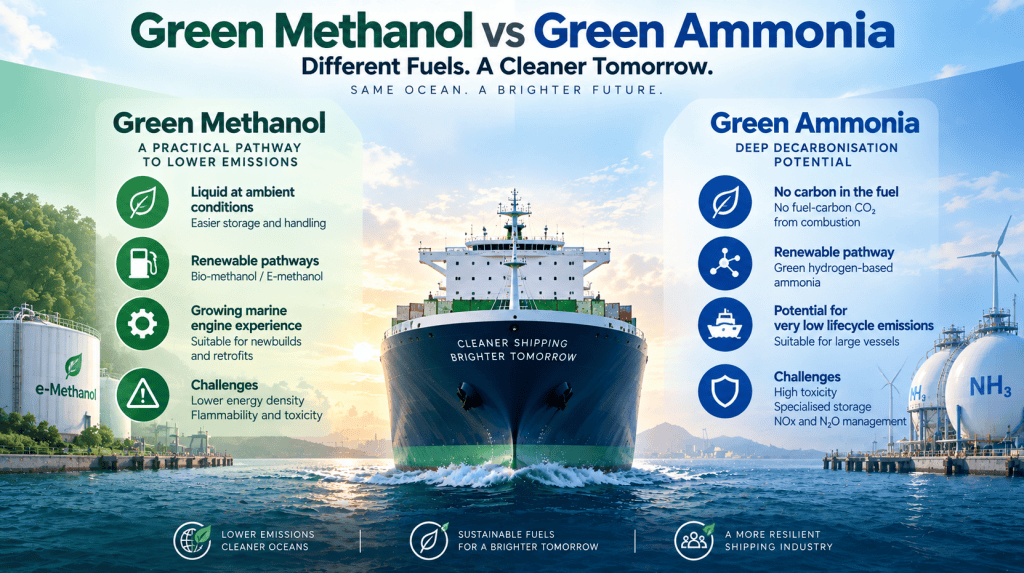
Methanol is gaining attention as an alternative marine fuel because it is a liquid at ambient temperature and can be stored and handled more easily than cryogenic fuels. It can be used in suitably designed marine engines, and its relatively straightforward storage requirements can make integration into vessels and fuel supply infrastructure more practical.
However, the environmental benefit of methanol depends strongly on how it is produced. Conventional methanol is generally produced from fossil feedstocks, while renewable methanol can be produced from biomass or from renewable hydrogen combined with captured carbon dioxide. Fuel availability, production cost, lifecycle emissions and the development of bunkering infrastructure will therefore be important factors in determining its long-term role in shipping.
3. Ammonia
Ammonia is attracting significant interest as a potential marine fuel because it contains no carbon in its molecular structure. When used as a fuel, it therefore does not produce carbon dioxide directly from combustion. If produced using renewable energy and low-carbon hydrogen, ammonia could offer significant potential for reducing greenhouse gas emissions from shipping.
However, ammonia presents important technical and safety challenges. It is toxic and requires careful handling, storage and fuel system design. Combustion also requires effective control of nitrogen oxide emissions and unburned ammonia. Its overall environmental benefit will depend heavily on how the ammonia is produced, making the availability and cost of low-carbon and renewable ammonia particularly important.
4. Hydrogen
Hydrogen is another potential zero-carbon energy carrier for shipping because it does not contain carbon and therefore does not produce carbon dioxide at the point of use. It can be used in fuel cells or suitable combustion engines, and when produced using renewable electricity, it has the potential to support significant reductions in lifecycle greenhouse gas emissions.
However, hydrogen presents significant challenges for marine applications, particularly in terms of storage and energy density. Compressed or liquefied hydrogen requires specialised storage systems, and liquid hydrogen must be maintained at extremely low temperatures. Safety, onboard space, fuel availability, infrastructure and cost will therefore be important considerations for its wider adoption in shipping.
5. Biofuels
Biofuels can provide a relatively practical pathway for reducing lifecycle greenhouse gas emissions because some types can be used in existing marine engines and fuel infrastructure with limited modifications. They can be produced from a variety of renewable feedstocks, including waste oils, agricultural residues and other biomass sources.
However, the sustainability of biofuels depends strongly on the feedstock and production pathway. Factors such as land use, feedstock availability, competition with other sectors and lifecycle greenhouse gas emissions need to be carefully considered. Sustainable feedstock supply and reliable certification will therefore be important if biofuels are to play a larger role in maritime decarbonisation.
6. Comparing Alternative Marine Fuels
Each alternative marine fuel offers different advantages and challenges, and no single option is likely to be suitable for every vessel. The most appropriate fuel will depend on factors such as vessel type, trading route, fuel availability, onboard storage requirements, safety, infrastructure, cost and lifecycle greenhouse gas emissions.
| Fuel | Carbon Content | Storage | Key Advantage | Key Challenge | Decarbonation Potential |
| LNG | Yes | Mature Technology and Infrastructure | Methan Slip and Fossil Origin | Moderate | Depending onProduction Pathway |
| Methanol | Yes | Liquid at Ambient Temperature | Relatively Easy Storage and Handling | Production Pathway and Fuel Availability | High when produced from renewable resources |
| Ammonia | No | Pressurised or refrigerated | No CO₂ emissions from combustion | Toxicity, safety and combustion challenges | High when produced with low-carbon energy |
| Hydrogen | No | Compressed or cryogenic | No CO₂ emissions at point of use | Low volumetric energy density and storage challenges | High when produced from renewable energy |
| Biofuels | Yes | Generally liquid | Potential compatibility with existing engines and infrastructure | Sustainable feedstock availability and lifecycle emissions | High when sustainably produced |
7. Choosing the Right Fuel for Each Vessel
Selecting the most suitable alternative fuel requires a vessel-specific assessment. Ship type, trading route, voyage length, available onboard space, engine technology and access to bunkering infrastructure can all influence which fuel option is technically and commercially viable.
Economic factors are equally important. Fuel price, vessel modification or newbuild costs, storage capacity, maintenance requirements and future fuel availability all need to be considered alongside emissions performance. For this reason, shipowners may adopt different fuel strategies depending on their fleet, trading patterns and long-term decarbonisation plans.
Conclusion
The transition to alternative marine fuels will be one of the most important changes facing the shipping industry in the coming decades. LNG, methanol, ammonia, hydrogen and biofuels each offer different pathways for reducing emissions, but each also presents its own technical, economic and environmental challenges.
Rather than relying on a single solution, the future marine fuel landscape is likely to involve a combination of different fuels and technologies. The most suitable pathway will depend on the characteristics and operating profile of each vessel, as well as the availability, cost and lifecycle emissions of future fuels. Careful evaluation of these factors will be essential as shipowners develop practical strategies for the transition towards lower-emission shipping.


답글 남기기