Introduction
As the shipping industry works towards lower greenhouse gas emissions, much of the attention has focused on alternative fuels such as methanol, ammonia and hydrogen.
However, replacing conventional marine fuels across the global fleet will take time.
This raises another important question:
Can ships continue using conventional fuels while capturing the CO₂ they produce?
Onboard Carbon Capture and Storage (OCCS) is being developed as one possible answer.
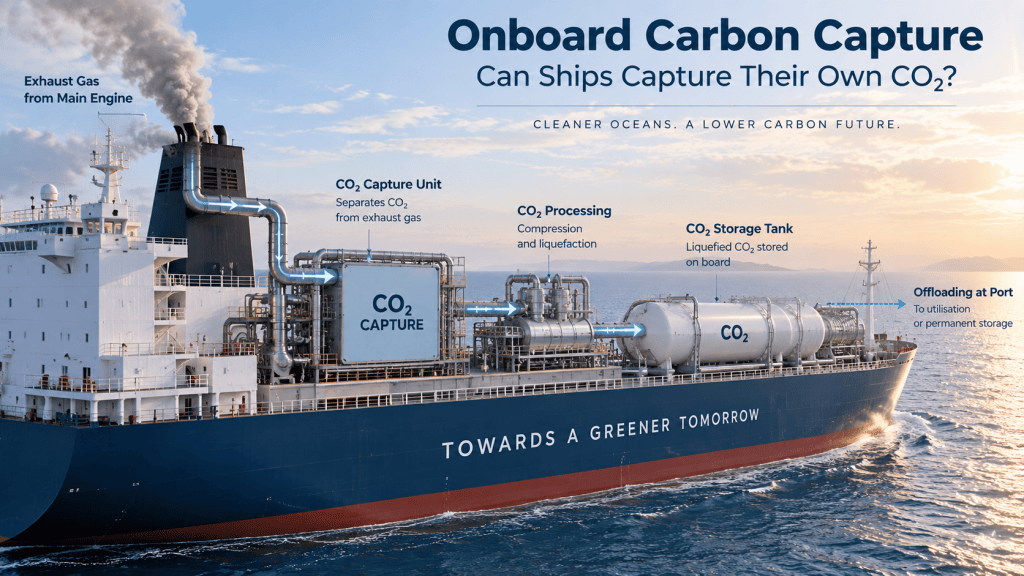
The concept is similar to carbon capture technology already used in land-based industries. Instead of releasing all combustion-related CO₂ into the atmosphere, an onboard system captures part of the CO₂ from the ship’s exhaust gas, processes it and stores it temporarily on board.
The captured CO₂ can then be discharged at a suitable port for utilisation, transportation or permanent storage.
IMO considers OCCS a potentially important technical solution for reducing greenhouse gas emissions from shipping and is developing a regulatory framework for its use.
1. What Is Onboard Carbon Capture?
Onboard Carbon Capture is the application of carbon capture technology directly to a ship.
A conventional engine burns fuel and produces exhaust gas containing CO₂. Normally, this CO₂ is released through the ship’s exhaust system into the atmosphere.
With OCCS, the process is different.
A simplified carbon capture chain can be described as:
Fuel combustion → Exhaust gas → CO₂ capture → CO₂ processing → Onboard storage → Offloading ashore
The objective is to prevent a portion of the CO₂ produced during vessel operation from reaching the atmosphere.
The captured carbon must then be handled properly after leaving the ship. It may potentially be used as an industrial feedstock or transported to a suitable location for permanent geological storage.
2. How Does Onboard Carbon Capture Work?
Several carbon capture technologies are being investigated for marine applications.
One approach involves separating CO₂ from exhaust gas using a chemical absorption process. The captured CO₂ is then separated from the absorbent and prepared for storage.
Depending on the system design, the process may involve:
- Exhaust gas treatment
- CO₂ absorption or separation
- Regeneration of the capture medium
- CO₂ purification
- Compression or liquefaction
- Temporary onboard storage
- Offloading to shore facilities
Alternative approaches are also under development, including technologies that convert captured CO₂ into other forms that may be easier to handle or store.
The most suitable solution will depend on factors including vessel type, engine configuration, available space, energy demand and the infrastructure available at ports.
3. Why Is Shipping Interested in Carbon Capture?
One of the main attractions of OCCS is that it may allow ships to reduce their atmospheric CO₂ emissions without immediately replacing their existing propulsion systems and fuels.
This could be particularly relevant for vessels with long remaining operational lives.
Replacing an existing ship’s propulsion system with a completely different fuel technology can require major modifications, new fuel tanks, new safety arrangements and new bunkering infrastructure.
OCCS could potentially provide another pathway.
Instead of changing the fuel immediately, the ship could continue operating with a carbon-containing fuel while capturing part of the resulting CO₂.
This is why OCCS is sometimes discussed as a potential transition or complementary technology while low- and zero-GHG fuels become more widely available. IMO’s 2025 technical seminar similarly discussed the possible role of OCCS as an interim measure while alternative fuels scale up.
4. The Energy Penalty
Carbon capture is not free from an energy perspective.
Capturing, separating, processing, compressing or liquefying CO₂ requires energy.
This means that an OCCS-equipped vessel may consume additional fuel or electrical power to operate the capture system.
Therefore, the important figure is not simply the percentage of CO₂ captured from the exhaust.
The more meaningful question is:
How much net greenhouse gas reduction is achieved after considering the additional energy required by the entire carbon capture system?
This is similar to evaluating an Air Lubrication System, where gross resistance reduction alone does not represent the vessel’s final net energy saving.
For OCCS, system efficiency will therefore be a critical factor in determining its environmental and commercial value.
5. Space and Weight Are Major Challenges
Ships have limited space.
An OCCS installation may require additional equipment for exhaust treatment, CO₂ separation, processing, liquefaction and storage.
Captured CO₂ also has to remain somewhere until the vessel reaches a suitable offloading facility.
This introduces additional:
- Equipment weight
- Storage volume
- Piping
- Electrical demand
- Cooling requirements
- Structural considerations
- Safety systems
These factors can affect cargo capacity, vessel arrangement and overall ship efficiency.
For retrofit projects in particular, finding sufficient space may be one of the biggest engineering challenges.
6. What Happens to the Captured CO₂?
Capturing CO₂ is only the first part of the process.
The complete carbon chain must also include:
Capture → Storage onboard → Port offloading → Transportation → Utilisation or permanent storage
If a ship captures CO₂ but there is no suitable facility at its destination to receive it, the system cannot operate as part of a complete carbon management chain.
Port infrastructure will therefore be extremely important.
IMO notes that captured CO₂ may be offloaded for use as a feedstock or for permanent storage. The expected expansion of carbon capture projects is also likely to increase demand for transporting liquefied CO₂ by ship.
7. Safety Considerations
Installing carbon capture equipment on a ship introduces new safety considerations.
These may include:
- CO₂ leakage
- High CO₂ concentrations in enclosed spaces
- Storage tank safety
- Pressure and temperature control
- Chemical handling
- Ventilation
- Emergency procedures
- CO₂ transfer during port operations
- Crew training
CO₂ is not flammable, but high concentrations can create a serious asphyxiation hazard.
Safety therefore needs to be considered across the complete system, from exhaust capture through onboard storage to final offloading.
Classification societies and regulators are developing requirements and guidance to support safe implementation.
8. Does Carbon Capture Make a Ship Zero-Emission?
No.
Installing OCCS does not automatically make a conventional ship a zero-emission vessel.
First, a carbon capture system will normally capture only part of the CO₂ produced.
Second, the system itself requires energy.
Third, greenhouse gas performance should increasingly be considered from a Well-to-Wake perspective.
Emissions associated with producing and transporting the fuel still matter.
Other greenhouse gases may also be relevant depending on the fuel and engine technology.
Therefore, OCCS should be evaluated based on its net lifecycle GHG reduction, rather than simply the amount of CO₂ removed from the exhaust.
9. OCCS and Well-to-Wake Emissions
Well-to-Wake analysis becomes particularly important when evaluating carbon capture.
Consider a ship using a fossil fuel.
Even if a significant portion of its onboard CO₂ is captured, upstream emissions may still occur during:
- Fuel extraction
- Processing
- Production
- Transportation
- Bunkering
The energy used by the capture system must also be considered.
This means the environmental performance of OCCS needs to be evaluated across the broader lifecycle rather than only at the ship’s funnel.
This approach is consistent with the shipping industry’s wider movement towards lifecycle-based GHG accounting.
10. IMO Regulation and OCCS
The regulatory framework for onboard carbon capture is still developing.
At MEPC 83 in April 2025, IMO approved a work plan to develop a regulatory framework for OCCS.
The work includes technical guidelines covering areas such as testing, survey, certification and approval of OCCS systems, together with measurement and verification of greenhouse gas emissions. IMO’s current work programme aims to develop the regulatory structure through 2028.
This is important because shipowners need clear rules defining how captured CO₂ will be measured, verified and recognised within future GHG regulations.
Without reliable accounting and verification, it would be difficult to determine the regulatory value of captured carbon.
11. Which Ships Could Benefit Most?
OCCS may not be equally suitable for every vessel.
Potential candidates could include:
- Large ocean-going vessels
- Ships with high annual fuel consumption
- Vessels with sufficient space for capture and storage equipment
- Ships operating regular routes with access to CO₂ reception infrastructure
- Existing vessels with significant remaining operational life
Large ships may have advantages because they generally offer more space and potentially greater economies of scale.
For smaller vessels, the additional equipment and CO₂ storage requirements may be more difficult to accommodate.
Ultimately, feasibility must be evaluated on a vessel-by-vessel basis.
12. Carbon Capture vs Alternative Fuels
OCCS and alternative fuels should not necessarily be viewed as competing solutions.
Alternative fuels aim to reduce lifecycle GHG emissions by changing the energy source itself.
Carbon capture takes a different approach: it attempts to prevent part of the carbon produced during fuel combustion from reaching the atmosphere.
Future vessels could potentially combine several approaches:
Lower-GHG fuel + onboard carbon capture + energy-efficiency technologies + voyage optimisation
This illustrates an important point about maritime decarbonisation.
There may not be one single technology capable of solving the entire challenge.
13. Can Onboard Carbon Capture Become Commercially Viable?
The technology is moving beyond purely theoretical research.
Real-ship projects and demonstrations are already providing practical experience, and IMO’s 2025 OCCS technical seminar included operational experience from existing onboard projects and large-scale demonstrations.
However, widespread commercial adoption will depend on more than whether CO₂ can technically be captured onboard.
Important questions remain:
- How much will the system cost?
- What is the net capture efficiency?
- How much additional fuel will it consume?
- How much cargo space will be lost?
- Where can captured CO₂ be discharged?
- How much will CO₂ transportation and permanent storage cost?
- How will captured CO₂ be recognised under international regulations?
- Who will ultimately own and manage the captured carbon?
The answers will determine whether OCCS becomes a niche solution or an important part of shipping’s decarbonisation pathway.
14. The Future of Onboard Carbon Capture
OCCS is unlikely to replace the development of low- and zero-GHG marine fuels.
Instead, it could become another tool in the maritime decarbonisation toolbox.
Its potential may be particularly interesting for existing vessels that cannot easily convert to new fuels, or for ships operating during the long transition period before alternative fuel production and bunkering infrastructure become widely available.
The future of OCCS will therefore depend on progress in four areas:
Technology + Regulation + Port Infrastructure + Carbon Storage
If these elements develop together, onboard carbon capture could become an important complementary pathway for reducing shipping emissions.
Conclusion
Ships can technically capture their own CO₂, and real-world projects are already demonstrating onboard carbon capture technologies.
However, capturing CO₂ at the funnel is only one part of the challenge.
The complete solution must consider energy consumption, equipment space, storage capacity, safety, port reception facilities, CO₂ transportation, permanent storage and lifecycle greenhouse gas performance.
IMO is actively developing a regulatory framework for OCCS, but this work is still ongoing.
For shipowners, the key question may therefore not simply be:
“Can we capture CO₂ onboard?”
but rather:
“Can we capture, store, offload and permanently manage CO₂ in a way that delivers a verified net GHG reduction at an acceptable cost?”
That question will ultimately determine how important onboard carbon capture becomes in the future of green shipping.


답글 남기기