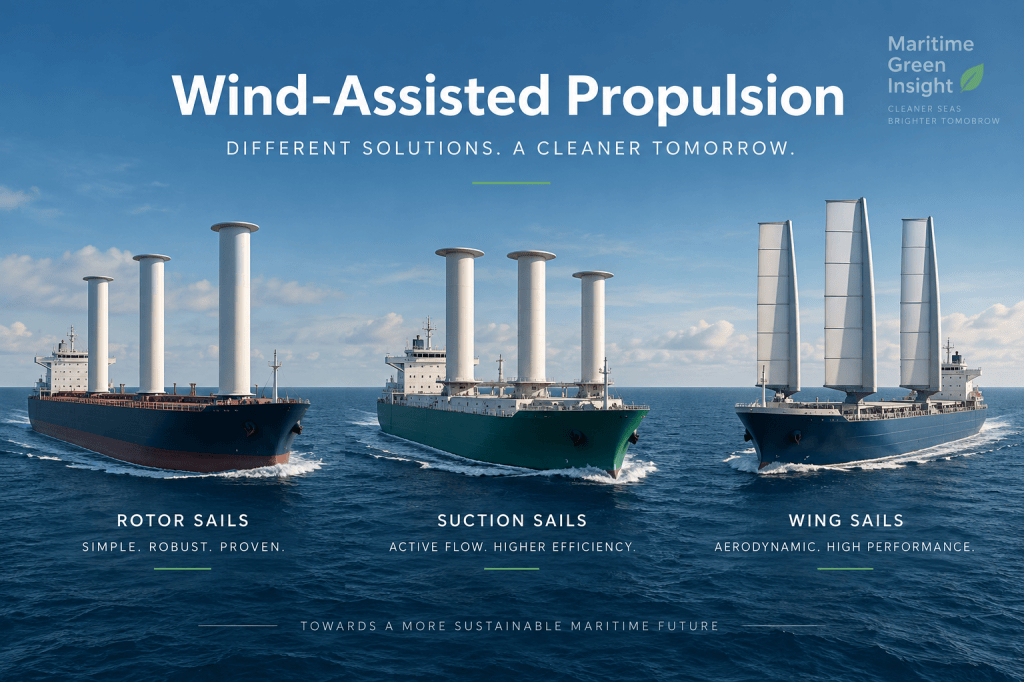
Wind has powered ships for thousands of years, but today it is returning to commercial shipping in a very different form. Modern Wind-Assisted Propulsion Systems (WAPS) use advanced engineering, automation and aerodynamic technologies to harness wind energy and reduce the propulsion power required from a vessel’s main engine.
As the maritime industry seeks practical ways to improve energy efficiency and reduce greenhouse gas emissions, WAPS is attracting increasing attention as a technology that can complement conventional propulsion systems and future low- and zero-carbon fuels.
1. Rotor Sails
Rotor sails are tall, rotating cylindrical structures installed on a vessel’s deck. As the cylinders rotate in the wind, they generate aerodynamic lift through the Magnus effect. This force can provide additional forward thrust, reducing the propulsion power required from the main engine under suitable operating conditions.
Rotor sails can operate automatically and can be integrated with a vessel’s existing propulsion system. However, their performance depends on factors such as wind speed and direction, vessel route and speed, available deck space and operational requirements. As rotating machinery, the system also requires consideration of power consumption, mechanical components and maintenance throughout its operating life.
2. Suction Sails
Suction sails are non-rotating aerodynamic structures that use controlled airflow and suction to enhance lift. By managing the airflow around the sail surface, they can generate aerodynamic force that contributes to vessel propulsion, helping to reduce the load on the main engine when wind conditions are favourable.
As suction sails do not rely on a rotating cylinder to generate aerodynamic lift, their mechanical configuration differs from rotor sails. When considering their application, shipowners and designers need to evaluate factors such as vessel type, route, wind conditions, available deck space, power consumption, structural integration and operational requirements.
3. Wing Sails
Wing sails are rigid or semi-rigid aerodynamic structures designed to generate lift in a similar way to an aircraft wing. Their angle and orientation can be adjusted according to wind conditions and vessel operation, allowing the generated aerodynamic force to assist the vessel’s propulsion and reduce the required engine power.
Wing sails can provide significant aerodynamic assistance under suitable wind conditions, but their integration requires careful consideration of deck arrangement, structural loads, visibility, cargo operations and vessel stability. Depending on the design, arrangements may also be required to fold, tilt or reposition the sails to minimise interference with port and cargo operations.
4. Comparing WAPS Technologies
There is no single WAPS technology that is ideal for every vessel. Rotor sails, suction sails and wing sails use different aerodynamic principles and have different requirements for installation, operation and maintenance. Their suitability therefore needs to be assessed according to the characteristics and operating profile of each vessel.
| Technology | Operating Principal | Key Characteristics | Key Considerations |
| Rotor Sails | Magnus effect from rotating cylinders | Automated rotating system | Deck space, power consumption and maintenance |
| Suction Sails | Controlled airflow and suction to enhance lift | Non-rotating aerodynamic structure | Deck space, power consumption and system integration |
| Wing Sails | Aerodynamic lift from rigid or semi-rigid wings | Adjustable aerodynamic structure | Deck arrangement, structural loads and cargo operations |
5. Key Considerations for WAPS Selection
Selecting the most suitable WAPS solution requires a vessel-specific assessment rather than simply comparing individual technologies. Vessel type, trading route, operating speed, wind conditions, available deck space and cargo operations can all influence the technical and economic suitability of a particular system.
The expected fuel and emissions savings should also be evaluated over the vessel’s actual operating profile. Installation cost, additional power consumption, maintenance requirements, system availability and potential operational constraints all need to be considered when assessing the overall economic benefit of a WAPS installation.
6. The Role of WAPS in Maritime Decarbonisation
WAPS should not be viewed as a replacement for the broader transition to low- and zero-carbon fuels. Instead, it can complement future fuel technologies by reducing the amount of energy a vessel requires for propulsion. Lower energy demand can, in turn, reduce fuel consumption and potentially ease some of the cost and availability challenges associated with future marine fuels.
This complementary role may become increasingly important as the shipping industry works to meet more stringent emissions requirements. By combining wind-assisted propulsion with efficient ship design, optimised operations and cleaner fuels, shipowners may be able to pursue a more flexible and integrated approach to decarbonisation.
Conclusion
Wind-assisted propulsion is bringing wind power back into commercial shipping through modern engineering and automation. Rotor sails, suction sails and wing sails each offer different approaches to harnessing wind energy, and their effectiveness will depend on the characteristics and operating conditions of each vessel.
Rather than asking which WAPS technology is universally the best, the more important question is which solution is best suited to a particular vessel, route and operating profile. As the technology continues to develop and experience from commercial installations grows, wind-assisted propulsion is likely to remain an important part of the wider discussion on improving shipping efficiency and reducing emissions.



답글 남기기