The maritime industry is entering a period of significant regulatory change as the International Maritime Organization (IMO) strengthens its efforts to reduce greenhouse gas emissions from international shipping. The 2023 IMO GHG Strategy sets an ambition to reach net-zero GHG emissions from international shipping by or around 2050, supported by intermediate targets and measures designed to improve ship efficiency and accelerate the transition towards lower-emission fuels and technologies.
To support this transition, the IMO Strategy includes indicative checkpoints to reduce total annual GHG emissions from international shipping by at least 20%, striving for 30%, by 2030, and by at least 70%, striving for 80%, by 2040, compared with 2008 levels. It also aims for zero or near-zero GHG emission technologies, fuels and energy sources to represent at least 5%, striving for 10%, of the energy used by international shipping by 2030.
1. EEXI and CII: Existing IMO Efficiency Measures
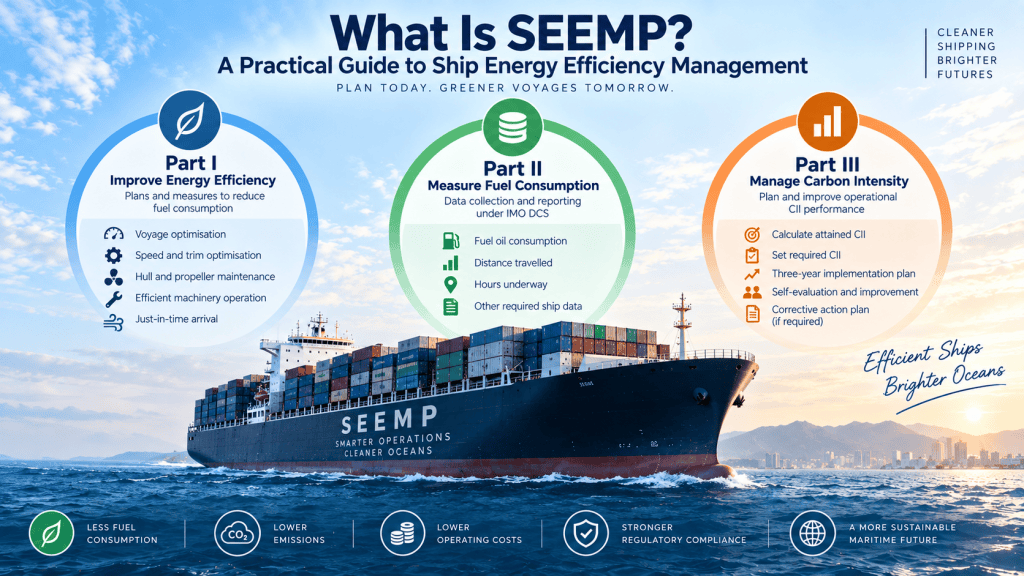
The Energy Efficiency Existing Ship Index (EEXI) and Carbon Intensity Indicator (CII) are among the key short-term measures introduced by the IMO to improve the energy efficiency and carbon performance of existing ships.
EEXI focuses primarily on the technical energy efficiency of a vessel, while CII measures how efficiently a ship transports goods or passengers in terms of CO₂ emissions during operation. Ships subject to the CII requirements receive an annual rating from A to E, with A representing the best performance. Ships with poor ratings may be required to develop corrective action plans to improve their operational carbon intensity.
These measures encourage shipowners to consider a range of efficiency improvements, including speed and operational optimisation, hull and propeller improvements, energy-saving technologies and other measures that can reduce fuel consumption and emissions.
2. The 2023 IMO GHG Strategy
The 2023 IMO Strategy on Reduction of GHG Emissions from Ships significantly strengthened the maritime industry’s long-term decarbonisation ambitions. The Strategy aims to reach net-zero GHG emissions from international shipping by or around 2050, taking into account different national circumstances.
It also establishes indicative checkpoints for reducing total annual GHG emissions from international shipping by at least 20%, striving for 30%, by 2030, and by at least 70%, striving for 80%, by 2040, compared with 2008 levels.
In addition, the Strategy aims for zero or near-zero GHG emission technologies, fuels and energy sources to represent at least 5%, striving for 10%, of the energy used by international shipping by 2030.
These targets indicate that improving vessel efficiency alone will not be sufficient. A broader transition involving alternative fuels, new technologies and more efficient vessel operation will also be required.
3. The IMO Net-Zero Framework
To support the objectives of the 2023 IMO GHG Strategy, the IMO has been developing a new package of mid-term measures known as the IMO Net-Zero Framework.
The draft framework contains two main elements: a global marine fuel standard designed to progressively reduce the GHG intensity of energy used by ships, and an economic mechanism that places a price on GHG emissions to encourage the use of lower-emission fuels and technologies.
The draft legal text was approved by the IMO’s Marine Environment Protection Committee in April 2025. However, discussions on its formal adoption were adjourned in October 2025 for one year, allowing IMO Member States additional time to work towards consensus. Therefore, as of 2026, the framework should be regarded as an important proposed regulatory development rather than a fully adopted global requirement.
4. Well-to-Wake Emissions and Lifecycle Assessment
Another important development is the growing focus on lifecycle greenhouse gas emissions. Evaluating only the emissions produced onboard a vessel may not provide a complete picture of the environmental impact of an alternative fuel.
The IMO’s lifecycle assessment approach considers emissions across the fuel pathway, from production and supply through to final use onboard the vessel. This is commonly described as a Well-to-Wake approach.
This distinction is particularly important when comparing fuels such as LNG, methanol, ammonia, hydrogen and biofuels. The same fuel may have very different lifecycle emissions depending on how it is produced, the energy source used during production and the emissions associated with its supply chain.
As a result, the future competitiveness of marine fuels is likely to depend increasingly on their verified lifecycle GHG performance rather than simply whether they produce CO₂ during combustion onboard the vessel.
5. What IMO Regulations Mean for Shipowners
For shipowners, increasingly stringent emissions requirements mean that decarbonisation decisions are becoming closely connected with long-term fleet planning. Improving operational efficiency may help existing vessels reduce fuel consumption and improve their carbon performance, but additional measures may be required as regulatory requirements become more demanding.
Possible solutions include hull and propeller optimisation, wind-assisted propulsion, air lubrication systems, energy-saving devices, digital optimisation and the gradual introduction of lower- and zero-GHG fuels.
However, the most appropriate strategy will differ between vessels. Ship age, vessel type, trading route, remaining operating life, available technology, fuel infrastructure and investment cost all need to be considered when determining whether to retrofit an existing vessel or invest in new tonnage.
6. The Growing Importance of Energy Efficiency
Even as the shipping industry moves towards alternative fuels, energy efficiency is likely to remain a fundamental part of maritime decarbonisation. Reducing the amount of energy required to propel a vessel can lower emissions regardless of the fuel being used.
Efficiency improvements may become even more valuable when vessels begin using alternative fuels that are more expensive, less energy-dense or less widely available than conventional marine fuels. Technologies such as wind-assisted propulsion and air lubrication can therefore complement the transition to cleaner fuels rather than compete with it.
This suggests that the future of maritime decarbonisation is likely to involve a combination of cleaner energy sources, more efficient ships and increasingly optimised vessel operations.
7. Preparing for the Next Phase of Maritime Regulation
The direction of IMO policy indicates that shipowners, shipyards, equipment suppliers and fuel producers will increasingly need to consider greenhouse gas performance across the entire lifecycle of ships and fuels.
Although some elements of the future regulatory framework are still under development, the overall direction is clear: shipping will need to become progressively more energy efficient while transitioning towards fuels and technologies with significantly lower lifecycle GHG emissions.
For the maritime industry, early evaluation of available technologies and fuel pathways can help reduce uncertainty and support better long-term investment decisions. Flexibility may also be important, particularly while future fuel availability, infrastructure and regulatory requirements continue to evolve.
Conclusion
IMO regulations are becoming an increasingly important driver of maritime decarbonisation. Existing measures such as EEXI and CII are already encouraging improvements in vessel efficiency, while the 2023 IMO GHG Strategy establishes a much broader pathway towards net-zero GHG emissions from international shipping by or around 2050.
At the same time, the development of lifecycle-based fuel regulation and the proposed IMO Net-Zero Framework signals a shift towards evaluating emissions across the entire energy pathway rather than focusing only on emissions produced onboard ships.
For shipowners, there is unlikely to be a single solution. The transition will require a combination of improved energy efficiency, operational optimisation, new technologies and lower-GHG fuels. Understanding how these elements interact with evolving IMO regulations will therefore be essential when planning the next generation of efficient and lower-emission ships.


답글 남기기